
Cataract surgery removes the eye’s clouded natural lens and replaces it with an artificial lens implant, restoring sharp, clear vision. At Ascend Eye Clinic, we offer all patients a wide range of lens implants to enhance spectacle independence for your lifestyle and work requirements.
Cataracts are a common eye condition in which the natural lens of the eye becomes cloudy, making vision less clear. Cataracts usually develop gradually and are most often linked to ageing. However, they can also be caused by eye injury, certain medications, or other underlying health conditions.
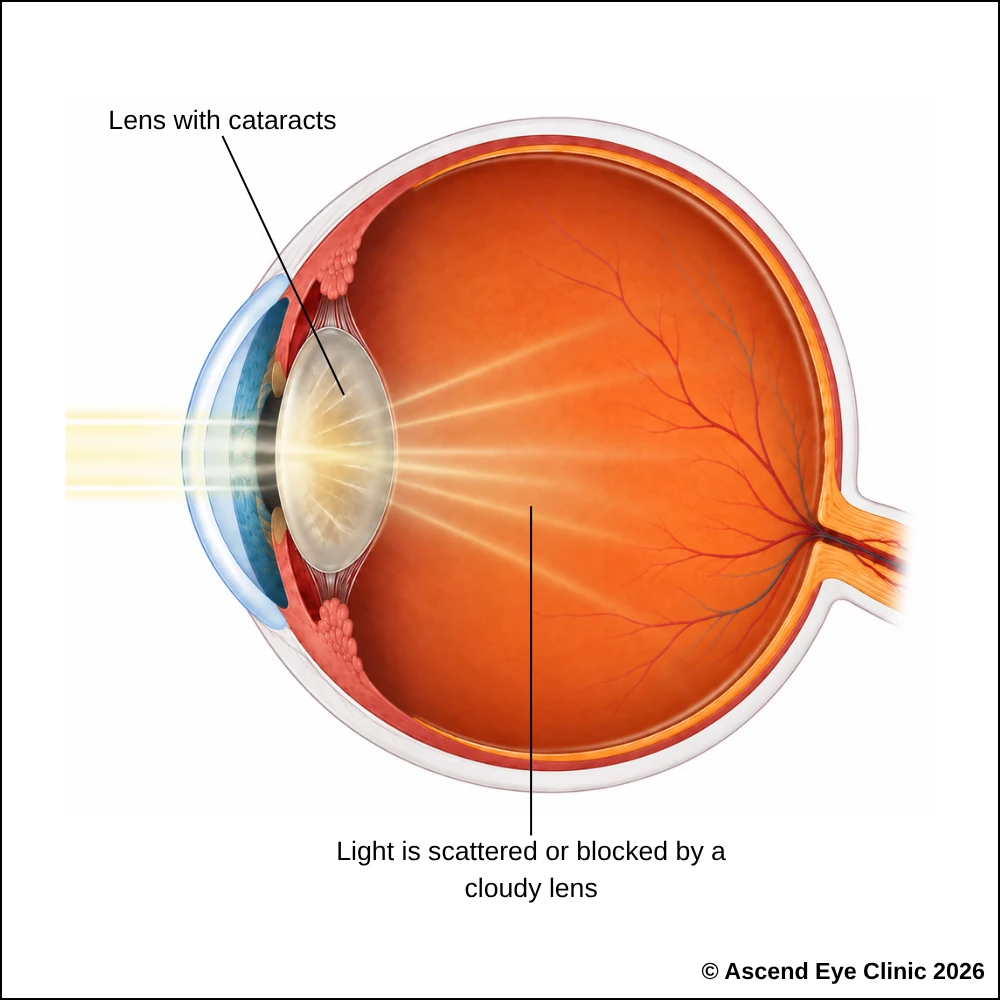
As the lens becomes less transparent, it becomes harder for light to enter the eye properly.
This can lead to a range of symptoms, including:


Difficulty seeing clearly, as though looking through a foggy window


Rings or starbursts around lights, especially at night


Colours may appear duller, less vibrant, or slightly yellowed


Reduced ability to see in low light


Seeing two overlapping images in one eye
While cataracts are often a natural part of ageing, there are several steps you can take to potentially delay their onset and reduce your risk:

Wearing sunglasses that block UV rays helps shield your eyes from sun damage.

Eating a healthy diet rich in fruits and vegetables help protect the lens from oxidative damage.

Conditions like diabetes can raise your risk of early cataracts, so keeping your overall health in check can help.

Both have been linked to a higher risk of developing cataracts.

The decision for cataract surgery is not based on a single measurement, but on how much your vision is affecting your daily life. Having cataract surgery can dramatically improve your vision, allowing you to enjoy work and day-to-day activities with much greater ease and confidence.
Many patients wait until their vision is badly affected before thinking about surgery. However, as cataracts become more advanced, they become harder to remove and the procedure can become more complicated. Having cataract surgery before the cataract becomes too advanced can lead to more consistent and predictable results. This also means a smoother procedure and an easier recovery.
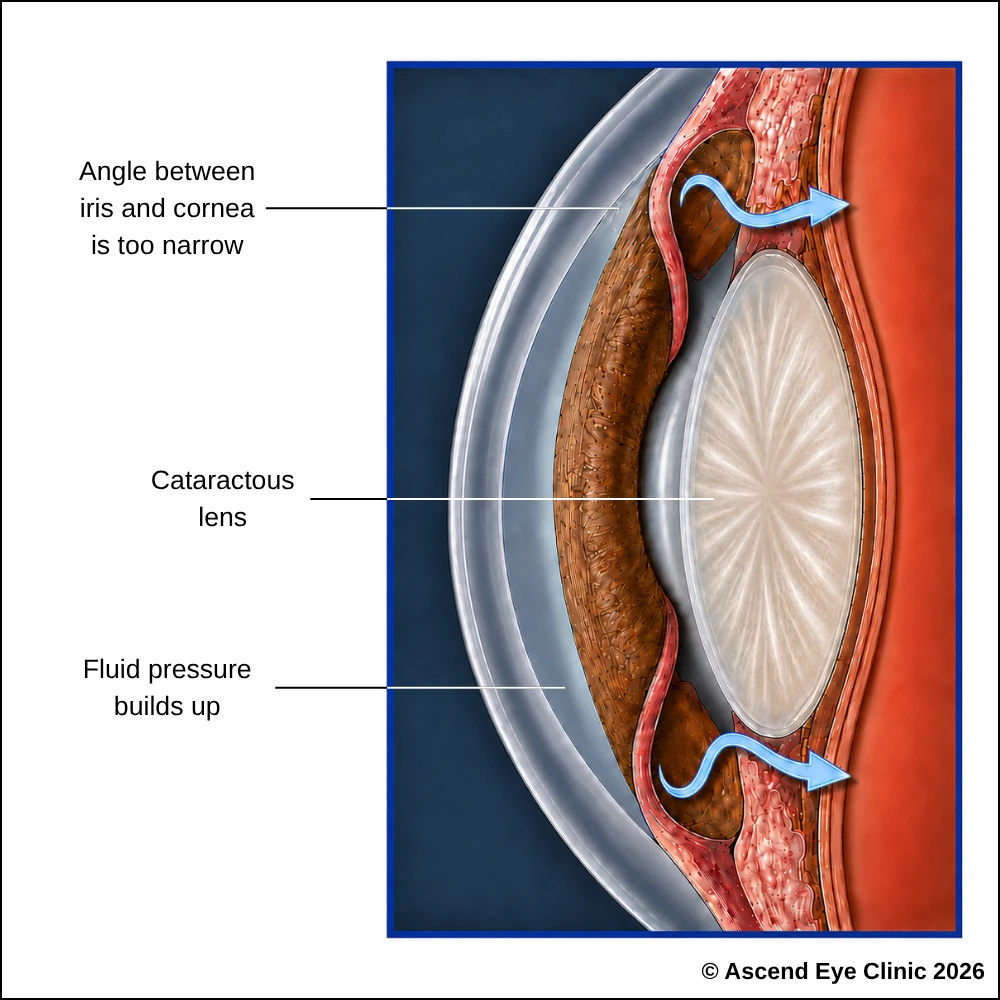
As a cataract develops, it thickens and gradually narrows the eye’s drainage pathway. This increases the risk of it becoming completely obstructed, causing a rise in eye pressure, which is termed angle closure. Cataract surgery involves removing the thickened lens and replacing it with a thin, artificial lens implant, thereby eliminating this possibility dramatically.
The only effective treatment for cataracts is cataract surgery, where the lens is removed and replaced with an artificial intraocular lens. There are no medications, eye drops, supplements, or exercises that can reverse the cataract once the lens has become cloudy.
Cataract surgery is a safe, minimally invasive procedure performed under local anaesthetic eye drops, with the cloudy lens typically removed in under 30 minutes. It’s carried out as a day surgery, and most patients are able to resume their regular activities within a few days. As with any surgical procedure, there are some risks involved, which we will explain in full before your surgery.
Conventional cataract surgery is a well established, highly effective technique using fine microsurgical instruments. Once the eye is numbed, a small incision is made manually and ultrasound energy is used to break the cataract into tiny pieces for removal in a process called phacoemulsification. The new artificial lens is then carefully positioned in its place.
Bladeless (laser-assisted) cataract surgery uses a femtosecond laser to assist with certain parts of the procedure, including creating the incision and pre-softening the cataract before removal. This added precision can reduce the amount of ultrasound energy required and may be particularly beneficial in cases where lens positioning is critical, such as with premium lens options.

At Ascend Eye Clinic, every cataract operation is carefully tailored to the individual. A comprehensive assessment of your eye health, lifestyle, and visual needs allows us to plan the procedure and select the most appropriate intraocular lens to achieve the best possible visual outcome.
Whether your priority is the sharpest distance vision, reducing dependence on glasses, or correcting astigmatism, your treatment plan is customised to your goals while maintaining the highest standards of safety and surgical precision.
Book a consultation with us today to find out which approach is right for you.
The intraocular lens used in your surgery is chosen based on your lifestyle and visual needs. Lenses can be designed to optimize distance vision, near vision, or a combination of both.
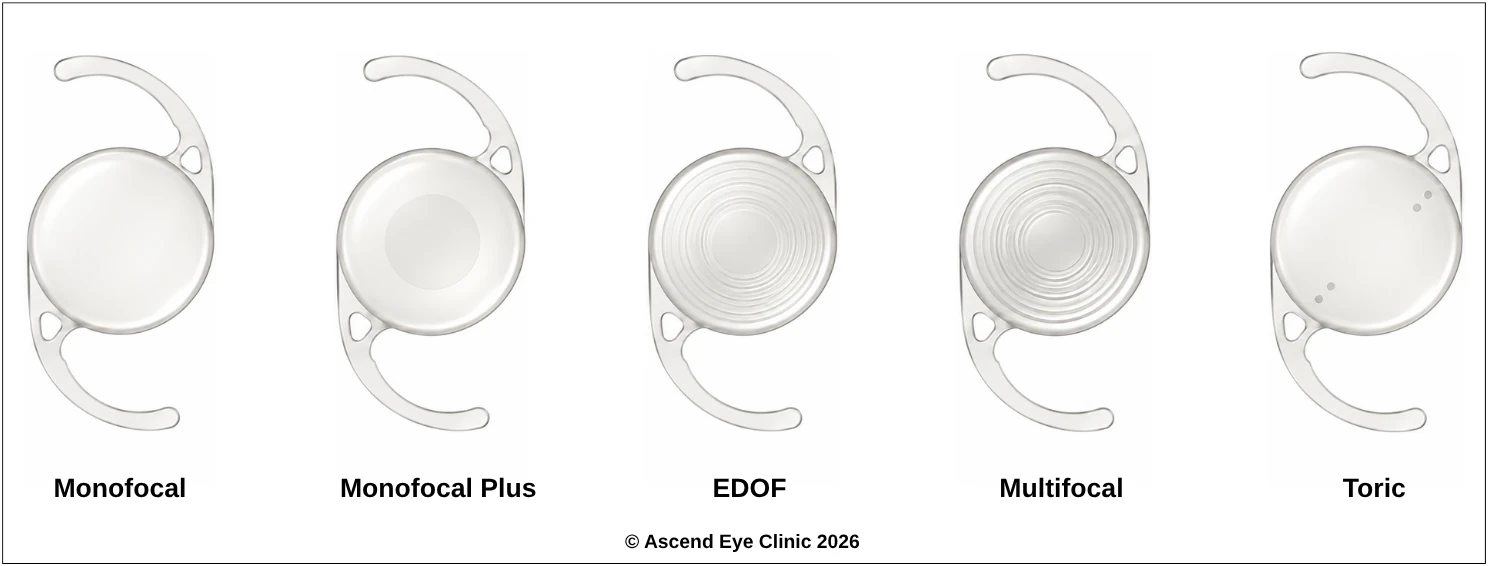
Correct vision at one chosen distance, most commonly far. Glasses are usually still required for intermediate and near activities.
Corrects distance vision while providing some additional intermediate vision. This reduces reliance on glasses for everyday intermediate tasks, although glasses are still needed for near work.
Corrects vision from distance through intermediate. This provides greater glasses independence for everyday activities, with reading glasses still needed for finer near tasks.
Corrects vision across distance, intermediate, and near. This provides the highest level of glasses independence across everyday activities.
Corrects astigmatism and can be incorporated into any of our different implant options. The level of glasses independence depends on whether the toric lens is monofocal, monofocal plus, EDOF or multifocal.
From your initial consultation to treatment and follow-up care, our team will guide you through every stage of your journey. We will take the time to explain your condition, answer your questions and help you feel informed and supported throughout your care.

Your consultation begins with a detailed assessment of your vision and eye health. Depending on your condition, this may include measurements of your vision and eye pressure, examination of the front and back of the eye, and advanced diagnostic imaging.
Our team will guide you through each test and explain what is being assessed. Your results will then be carefully reviewed to understand your individual needs and determine whether monitoring or treatment may be recommended.
Every eye and every patient is different. Your treatment plan will be tailored according to your examination findings, visual needs, general health and lifestyle.
We will explain the recommended treatment, its expected benefits, possible risks and any suitable alternatives in a clear and straightforward manner. You will have time to ask questions and consider your options before deciding how you would like to proceed.
Before your treatment, our team will guide you through the necessary preparations, paperwork and medication instructions. Where applicable, we will explain how to use your prescribed eye drops and how to care for your eyes afterwards.
We understand that undergoing a procedure can feel unfamiliar or worrying. Our team will be available to answer your questions and ensure that you know what to expect before the day of your treatment.
On the day of your procedure, you will arrive at the hospital or surgical centre where your operation has been scheduled. The surgical team will help you prepare and explain what will happen at each stage.
Anaesthetic eye drops or other forms of anaesthesia may be used, depending on the procedure, to keep you comfortable. Your doctor and the surgical team will support and reassure you throughout the operation.
Most eye surgeries are performed as day procedures, although the duration and recovery process will depend on the treatment you receive. Your vision may be temporarily blurred afterwards, so you should arrange for someone to accompany you home and should not drive unless your doctor has advised that it is safe to do so.
We will provide clear instructions on how to care for your eyes, use any prescribed medication and manage your activities during recovery. We will also explain which symptoms are expected and when you should contact the clinic for further advice.
Follow-up appointments allow us to monitor your vision, assess your recovery and identify any concerns at an early stage. Our team remains accessible should you have any questions or concerns throughout your recovery.
At Ascend Eye Clinic, we understand that understanding cataract surgery can feel overwhelming. That is why we take a personalised approach to patient care, ensuring you have the time and support you need to make an informed decision with confidence.
Ready to take the next step? Book a consultation with us to discuss your treatment options and receive a personalised assessment tailored to your vision needs.
The surgery itself is relatively quick. From preparation through to the end of the procedure, you can expect it to take around 15 - 20 minutes per eye.
After surgery, you will rest in a recovery area while we monitor you and administer your post-operative eye drops. You will be able to keep your eye open and see through it, although your vision will still be blurry at first. Once you are comfortable and the sedation has worn off, you will be able to eat and drink. Before you go home, we will explain how to use your eye drops and what to expect over the next few days. It is best to have a family member or friend to accompany you home.
No. Cataract surgery is performed as a day surgery, so you can return home on the same day after a short period of recovery and observation.
Cataract surgery is performed as a day surgery and is covered under insurance plans. We can assist with the necessary financial counselling, insurance submissions, and supporting documentation for your claim.
By the next day, you should already be able to see much more clearly than before surgery, although your vision will not yet be at its final best. Over the next 3-4 days, the vision usually improves further as the eye settles and dryness improves.
Some fluctuation in vision can continue over the next 2-3 weeks, particularly from dryness, but this gradually settles with the prescribed eye drops.
We perform cataract surgery on one eye at a time. The second eye is scheduled separately, allowing us to assess how the first eye has healed and how the vision has settled before proceeding with surgery on the other eye.
You can resume daily activities such as housework and light exercise within a day or two. Most people can drive the very next day after cataract surgery after we have cleared your vision. You will be able to return to strenuous exercise within 1 week and swimming within 2 weeks.
Cataract surgery is one of the safest and most successful operations performed today. The vast majority of patients experience a significant improvement in vision, making everyday activities such as driving, reading, working, and enjoying hobbies easier and more comfortable. Visual outcomes also depend on the overall health of the eye.
Serious complications are very uncommon. These include infection, bleeding, corneal swelling, retinal detachment, and displacement of the lens implant. We will discuss the risks that are most relevant to your individual eye before surgery, and treatment is available for each of these problems should they occur.
Mild blurring, watering, light sensitivity, or a gritty sensation are common for the first few days and usually improve as the eye heals, with the application of post-operative eye drops.
Before surgery on the second eye, we will review how the first eye has healed and how the vision has settled, then repeat only the measurements or scans that are needed. If surgery for the second eye is planned much later, we will repeat the relevant measurements to make sure the treatment plan and lens calculations are based on up-to-date results.
The eye operated on first will depend on your eye condition and visual needs. There can also be specific considerations based on the type of lens implants chosen, and we will advise you on the most appropriate sequence of surgery.
We perform cataract surgery under local anaesthetic with mild sedation. You will not be fully unconscious as you would be under general anaesthesia, but the sedation keeps you very relaxed and unaware of what is happening around you during the procedure.
Before surgery, we take detailed measurements and scans of your eye to calculate the appropriate lens power and plan its position. During surgery, we use modern guidance technology together with these measurements to carry out the procedure according to the individual treatment plan.
No. Once the cataract has been removed, it cannot grow back. Some patients later develop clouding of the thin membrane behind the lens implant, which can blur the vision again and is treated with a short YAG laser procedure. Learn more about this at our dedicated YAG Laser Capsulotomy page.
Hi, I would like to book a consultation with Dr Errol Chan from Ascend Eye Clinic
