
We use detailed retinal imaging to direct photodynamic therapy precisely towards abnormal or leaking blood vessels beneath the retina. This targeted approach combines a light-activated medication with controlled laser treatment while protecting the surrounding retinal tissue.
Photodynamic therapy (PDT) is used for retinal and choroidal conditions involving abnormal blood vessels, excessive vascular leakage or fluid accumulation beneath the retina including;
These changes affect the macula and cause blurred or distorted central vision and can potentially lead to permanent retinal damage when persistent.
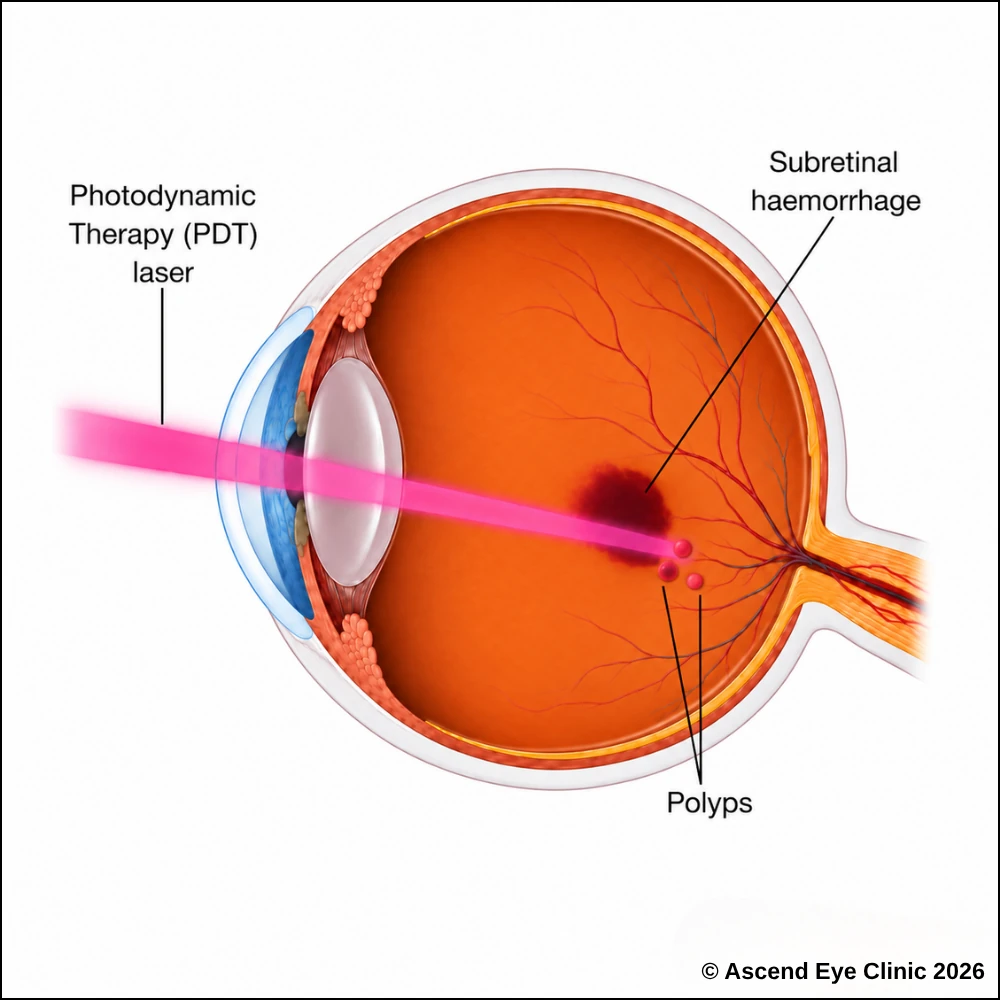
Photodynamic therapy is used to treat selected retinal conditions involving abnormal or excessively leaky blood vessels beneath the retina, including polypoidal choroidal vasculopathy and chronic central serous chorioretinopathy.
The treatment involves the use of a light-sensitive medication called Visudyne® together with a non-thermal laser. Visudyne® is administered through a vein in the arm and circulates to the blood vessels at the back of the eye, where it is absorbed by abnormal, leaky blood vessels. Once activated by the laser, these vessels close, reducing fluid leakage and limiting damage to the surrounding retinal tissue.
Before the laser is applied, local anaesthetic drops are used to numb the eye and a specialised contact lens is placed on the surface of the eye. The laser is then directed at the affected area for approximately a minute to activate the medication.
Photodynamic therapy is performed as an outpatient procedure, and you can return home on the same day. Treatment can be repeated when required, with follow-up retinal imaging used to monitor the response and determine whether further treatment is needed.
From your initial consultation to treatment and follow-up care, our team will guide you through every stage of your journey. We will take the time to explain your condition, answer your questions and help you feel informed and supported throughout your care.
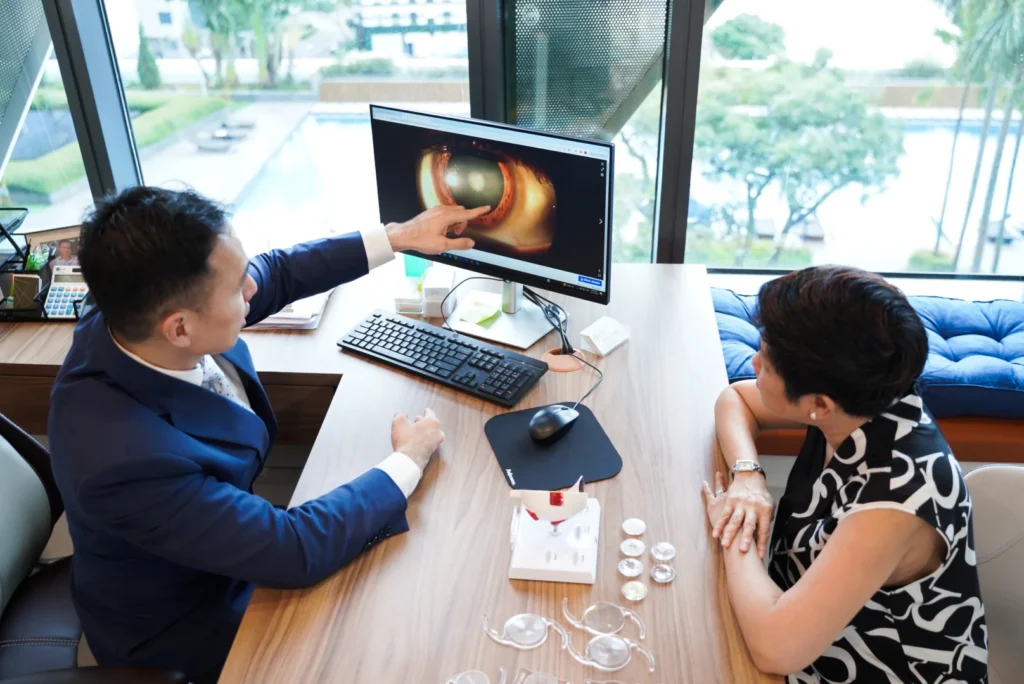
Your consultation begins with a detailed assessment of your vision and eye health. Depending on your condition, this may include measurements of your vision and eye pressure, examination of the front and back of the eye, and advanced diagnostic imaging.
Our team will guide you through each test and explain what is being assessed. Your results will then be carefully reviewed to understand your individual needs and determine whether monitoring or treatment may be recommended.
Every eye and every patient is different. Your treatment plan will be tailored according to your examination findings, visual needs, general health and lifestyle.
We will explain the recommended treatment, its expected benefits, possible risks and any suitable alternatives in a clear and straightforward manner. You will have time to ask questions and consider your options before deciding how you would like to proceed.
Before your treatment, our team will guide you through the necessary preparations, paperwork and medication instructions. Where applicable, we will explain how to use your prescribed eye drops and how to care for your eyes afterwards.
We understand that undergoing a procedure can feel unfamiliar or worrying. Our team will be available to answer your questions and ensure that you know what to expect before the day of your treatment.
On the day of your procedure, you will arrive at the hospital or surgical centre where your operation has been scheduled. The surgical team will help you prepare and explain what will happen at each stage.
Anaesthetic eye drops or other forms of anaesthesia may be used, depending on the procedure, to keep you comfortable. Your doctor and the surgical team will support and reassure you throughout the operation.
Most eye surgeries are performed as day procedures, although the duration and recovery process will depend on the treatment you receive. Your vision may be temporarily blurred afterwards, so you should arrange for someone to accompany you home and should not drive unless your doctor has advised that it is safe to do so.
We will provide clear instructions on how to care for your eyes, use any prescribed medication and manage your activities during recovery. We will also explain which symptoms are expected and when you should contact the clinic for further advice.
Follow-up appointments allow us to monitor your vision, assess your recovery and identify any concerns at an early stage. Our team remains accessible should you have any questions or concerns throughout your recovery.
Persistent fluid or abnormal blood vessels beneath the retina can continue to affect central vision. At Ascend Eye Clinic, detailed retinal imaging helps determine whether photodynamic therapy is suitable for your condition and whether it should be combined with other treatments.
Book a consultation for a personalised retinal assessment and treatment plan.
Photodynamic therapy is used for selected retinal and choroidal conditions where abnormal or leaking blood vessels are contributing to fluid beneath the retina or changes in central vision. We use it when the pattern of disease and retinal imaging suggest that PDT is an appropriate treatment option.
A light-sensitive medication is given through a vein in the arm and travels through the bloodstream to the abnormal blood vessels beneath the retina. A non-thermal laser is then directed at the affected area, activating the medication and helping to reduce leakage from these vessels.
The treatment itself is generally well tolerated. You may feel a brief sting when the intravenous line is inserted, but the laser treatment does not involve cutting the eye or injecting medication into the eye. We will guide you through each stage of the procedure.
Yes. PDT is performed while you are awake. Your pupil is dilated, and a special contact lens can be placed on the eye to allow us to accurately direct the treatment to the affected area.
The laser treatment itself is brief, although the overall appointment takes longer because the medication needs to be given through a vein and allowed to circulate before the laser is applied.
You may notice a bright light while the laser is being applied. We will ask you to keep your eye steady and look in a particular direction while the treatment is delivered to the planned area.
Your vision can be temporarily blurred after PDT because your pupils have been dilated and the retina has just been treated. Some patients also notice temporary changes in brightness or contrast. These generally settle as the eye recovers.
The aim of treatment is often to reduce leakage and stabilise the retina rather than produce an immediate improvement in vision. Visual recovery depends on the underlying condition, how long the retina has been affected and whether there is already permanent retinal damage.
The response develops gradually. We will monitor the retina with follow-up examinations and imaging, such as OCT, to assess whether fluid and leakage have reduced and whether further treatment is needed.
Some patients require only one session, while others may need repeat treatment if fluid or leakage persists or returns. We will base this on how the retina responds over time.
The medication used during PDT makes the skin and eyes temporarily more sensitive to bright light. For a period after treatment, exposure to direct sunlight or strong indoor light can cause a skin reaction, so careful light protection is important.
You will need to avoid direct sunlight and intense artificial light for the period advised after treatment because the medication temporarily increases sensitivity to light. Wear protective clothing and sunglasses when necessary, and avoid activities such as tanning or prolonged outdoor exposure. Driving should also be avoided until your vision has cleared sufficiently.
Most light daily activities can be resumed soon after treatment, but you will need to follow the light-protection precautions carefully. Your vision may also be temporarily blurred, so driving should be avoided until you can see clearly and safely again.
Temporary blurred vision, visual disturbance and sensitivity to light can occur after treatment. Less commonly, there can be a temporary reduction in vision or changes in the treated retinal area. We will explain the relevant risks based on your condition before proceeding.
Contact us promptly if you notice a significant or sudden drop in vision, increasing distortion, severe eye pain, marked redness or any other concerning change after treatment. We would rather assess an unexpected symptom early and make sure the eye is recovering as expected.
Hi, I would like to book a consultation with Dr Errol Chan from Ascend Eye Clinic
