
Experience a fuller range of vision from the open road to the screen in your hands.
During cataract surgery, the cloudy natural lens is removed and replaced with an artificial intraocular lens implant. This lens shapes how well you see after surgery, so choosing the right option matters.
A standard monofocal lens implant corrects vision primarily at one distance. This often means relying on glasses again for activities outside the chosen focal range.
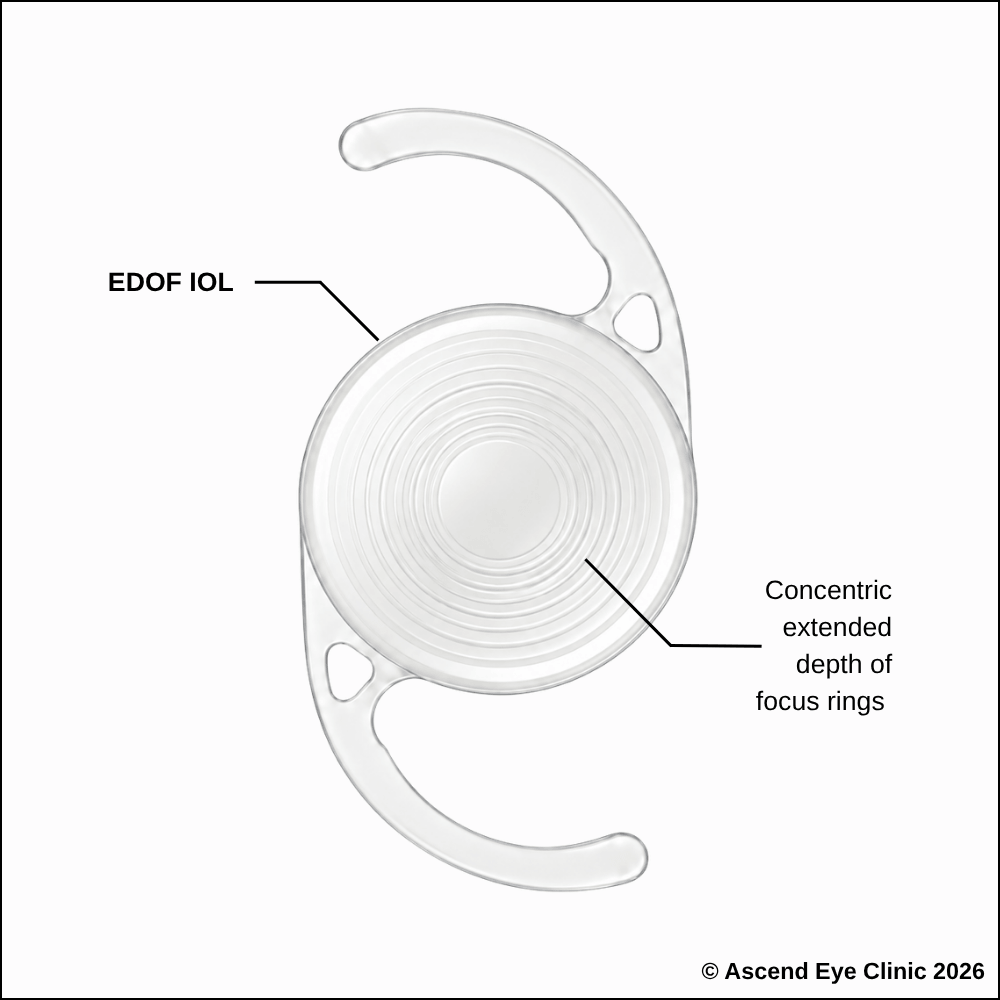
An Extended Depth of Focus, or EDOF, lens implant provides sharp distance vision together with strong intermediate vision for everyday activities such as driving and using digital screens. It offers a wider range of vision and reduces dependence on glasses compared with a standard monofocal lens implant.
Instead of focusing light at only one point, an EDOF lens implant extends light across a continuous focal zone. This creates a gradual range of vision from distance to intermediate, allowing you to move more naturally between activities such as looking at the road, viewing the dashboard and using a computer.
Multifocal lens implants divide incoming light between separate distance, intermediate and near focal zones. EDOF lens implants create a single elongated focal range instead, producing fewer nighttime visual disturbances such as glare and halos than multifocal designs.
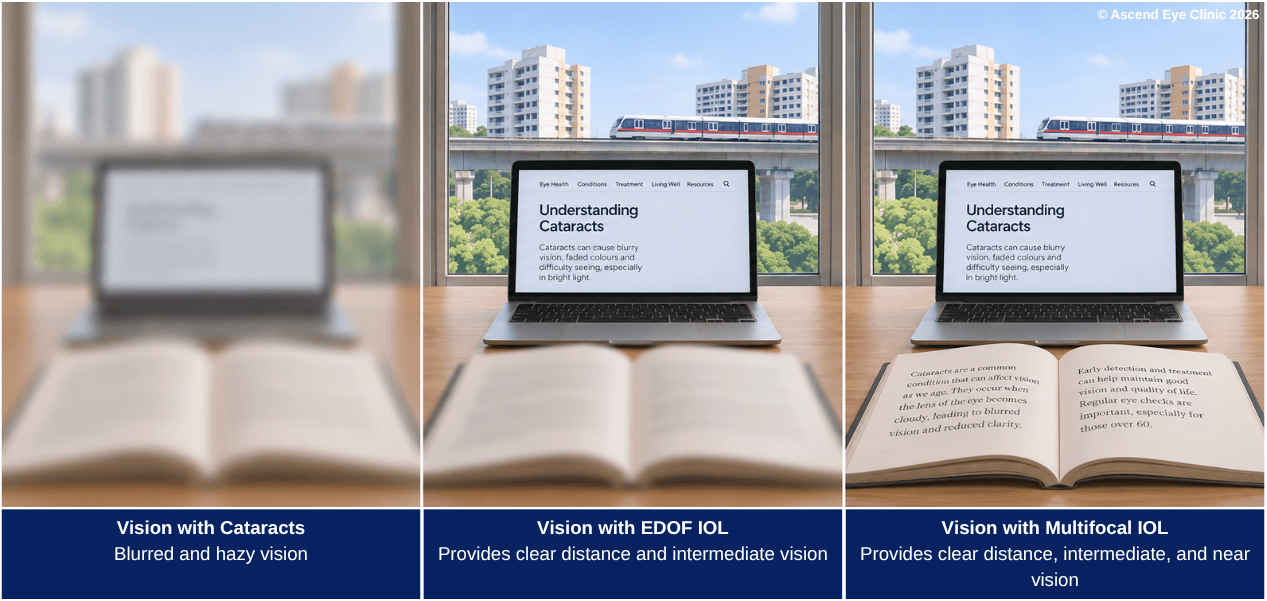
You can expect sharp distance vision together with strong intermediate vision for driving, computer work and other daily activities. Most patients experience reduced dependence on glasses compared with a standard monofocal lens implant. Vision often feels close to the natural range experienced before cataracts developed.
EDOF lens implants provide less near vision than multifocal lens implants. Reading glasses are therefore still required by some patients for fine print and demanding close-up tasks.

EDOF lens implants are designed to provide clear distance vision while extending the range of focus into intermediate distances. They are often chosen by people with active lifestyles involving frequent driving, computer work and digital screen use, who want less dependence on glasses for everyday activities.
Reading glasses are still usually needed for small print, mobile phone use and other close-up work. The level of glasses independence achieved differs between individuals and depends on your visual target and overall eye health.
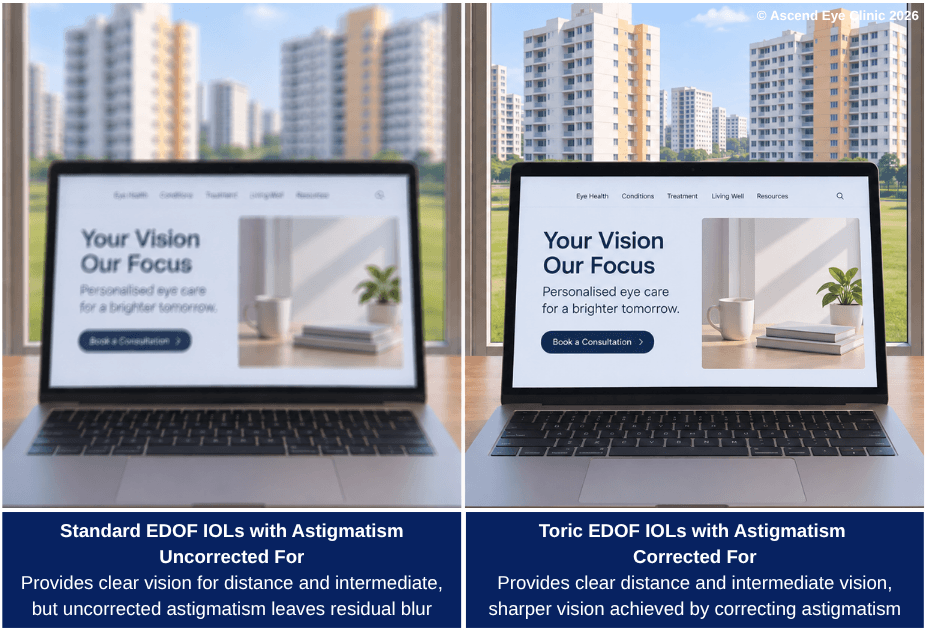
Astigmatism occurs when the cornea or natural lens has an uneven curvature, causing light to focus unevenly and resulting in blurred or distorted vision. For patients with significant astigmatism, a toric version of the lens implant may be selected to correct astigmatism at the same time as cataract surgery, helping to improve visual clarity and reduce dependence on glasses.
The same lens implant does not always need to be used in both eyes. In selected patients, different lens implant technologies may be chosen for each eye to create a more personalised balance of distance, intermediate and near vision.
For example, one eye may be optimised more strongly for distance vision, while the other provides greater support for intermediate or near tasks. This customised approach takes into account factors such as eye dominance, existing astigmatism, visual requirements and lifestyle.
Detailed measurements and discussion of visual priorities help determine whether using different lens implants between the two eyes may provide a better overall visual outcome.

From your initial consultation to treatment and follow-up care, our team will guide you through every stage of your journey. We will take the time to explain your condition, answer your questions and help you feel informed and supported throughout your care.

Your consultation begins with a detailed assessment of your vision and eye health. Depending on your condition, this may include measurements of your vision and eye pressure, examination of the front and back of the eye, and advanced diagnostic imaging.
Our team will guide you through each test and explain what is being assessed. Your results will then be carefully reviewed to understand your individual needs and determine whether monitoring or treatment may be recommended.
Every eye and every patient is different. Your treatment plan will be tailored according to your examination findings, visual needs, general health and lifestyle.
We will explain the recommended treatment, its expected benefits, possible risks and any suitable alternatives in a clear and straightforward manner. You will have time to ask questions and consider your options before deciding how you would like to proceed.
Before your treatment, our team will guide you through the necessary preparations, paperwork and medication instructions. Where applicable, we will explain how to use your prescribed eye drops and how to care for your eyes afterwards.
We understand that undergoing a procedure can feel unfamiliar or worrying. Our team will be available to answer your questions and ensure that you know what to expect before the day of your treatment.
On the day of your procedure, you will arrive at the hospital or surgical centre where your operation has been scheduled. The surgical team will help you prepare and explain what will happen at each stage.
Anaesthetic eye drops or other forms of anaesthesia may be used, depending on the procedure, to keep you comfortable. Your doctor and the surgical team will support and reassure you throughout the operation.
Most eye surgeries are performed as day procedures, although the duration and recovery process will depend on the treatment you receive. Your vision may be temporarily blurred afterwards, so you should arrange for someone to accompany you home and should not drive unless your doctor has advised that it is safe to do so.
We will provide clear instructions on how to care for your eyes, use any prescribed medication and manage your activities during recovery. We will also explain which symptoms are expected and when you should contact the clinic for further advice.
Follow-up appointments allow us to monitor your vision, assess your recovery and identify any concerns at an early stage. Our team remains accessible should you have any questions or concerns throughout your recovery.
If you’re looking to reduce your dependence on glasses while maintaining excellent visual quality, EDOF lenses may be the right choice. We will assess your eyes, lifestyle, and visual needs to determine whether an EDOF lens is suitable for you.
Book a consultation to find out if EDOF lenses match your vision.
An EDOF lens is designed to provide a continuous range of vision, with strong distance and intermediate vision. This is particularly useful for activities such as driving, working on a computer, viewing a dashboard and seeing across a room.
For very close or detailed tasks, such as reading small print, reading in dim lighting or prolonged near work, reading glasses are still useful. The amount of near vision also depends on how the two eyes are planned.
A monofocal lens is primarily focused at one distance, usually far vision. An EDOF lens extends the usable range of focus so that intermediate objects remain clearer without constantly reaching for glasses.
EDOF lenses emphasise a smooth range from distance through intermediate vision, while multifocal lenses are designed to provide stronger vision across several distances, including near. We will discuss the visual range and optical side effects of each option according to your priorities.
EDOF lenses are strongest for distance and arm’s-length vision. Comfortable reading distance varies according to the lens design, prescription target and how the two eyes work together. Very small print at close range generally still requires reading glasses.
Halos, glare and other light-related symptoms can occur with EDOF lens implants. Their frequency and intensity differ between lens designs and individuals, and these symptoms often become less noticeable as the visual system adapts.
Night-driving requirements are an important part of lens selection. We will consider your sensitivity to glare, visual priorities and eye health before recommending an EDOF lens, particularly when night driving is a major part of your lifestyle.
EDOF lenses are available in toric versions for suitable levels of corneal astigmatism. Correcting significant astigmatism at the same time helps achieve a sharper and more consistent range of vision.
Not necessarily. The lens choice and focusing target for each eye are planned together. Depending on your visual requirements and eye health, we can use the same lens design in both eyes or personalise the lens strategy between the two eyes.
Each eye is assessed individually. If an EDOF lens is not appropriate for one eye, we will plan the two eyes together and select a combination that provides the best balance of visual quality and range.
The health of the cornea, optic nerve, macula and retina influences whether an EDOF lens is appropriate. We will assess these structures carefully before recommending the most suitable lens option.
Previous laser vision correction changes the way lens power calculations are performed. We will take additional measurements and review the previous treatment where information is available before deciding whether an EDOF lens is suitable.
Vision generally improves as the eye recovers, but the final quality and range of vision are not judged immediately after surgery. The eye needs time to heal, the prescription needs to stabilise and the brain needs to become accustomed to the new optical system.
Adaptation differs between individuals. Distance and intermediate vision are often functional early in recovery, while awareness of glare, halos or differences between viewing distances generally becomes less noticeable with time.
A small residual prescription can remain despite careful lens calculations. We will assess whether it meaningfully affects your vision and discuss the appropriate correction, ranging from occasional spectacles to further treatment in selected cases.
The implanted lens is designed to remain permanently inside the eye. It does not require routine replacement simply because many years have passed.
The cataract itself does not return because the natural lens has been removed. The thin capsule behind the implant can become cloudy later, causing vision to become hazy again. This is called posterior capsule opacification and is treated with a short YAG laser procedure when required.
We will first identify the reason for the dissatisfaction. Residual prescription, dry eye, posterior capsule changes, lens position and retinal or corneal conditions can all affect visual quality. Treatment is directed at the underlying cause, with lens exchange reserved for selected situations.
No lens implant guarantees complete freedom from spectacles for every activity. EDOF lenses are designed to reduce dependence on glasses by extending the range of useful vision, particularly from distance through intermediate tasks.
We will assess your eye health, prescription, corneal measurements, astigmatism and retinal function, together with the activities that matter most to you. Lens selection is then personalised around the range of vision you want and the visual trade-offs you are comfortable accepting.
Hi, I would like to book a consultation with Dr Errol Chan from Ascend Eye Clinic
