
Cataract surgery goes beyond removing the cloudy natural lens. Detailed diagnostic imaging and eye measurements, together with a range of lens implant options, allow treatment to be planned according to each individual’s eyes, lifestyle and visual goals, with the aim of improving vision and reducing dependence on glasses.
Cataracts occur when the natural lens inside the eye becomes cloudy, preventing light from focusing clearly on the retina. They usually develop gradually with age, although eye injuries, certain medications, and underlying health conditions can also contribute.
Symptoms of Cataracts Include:
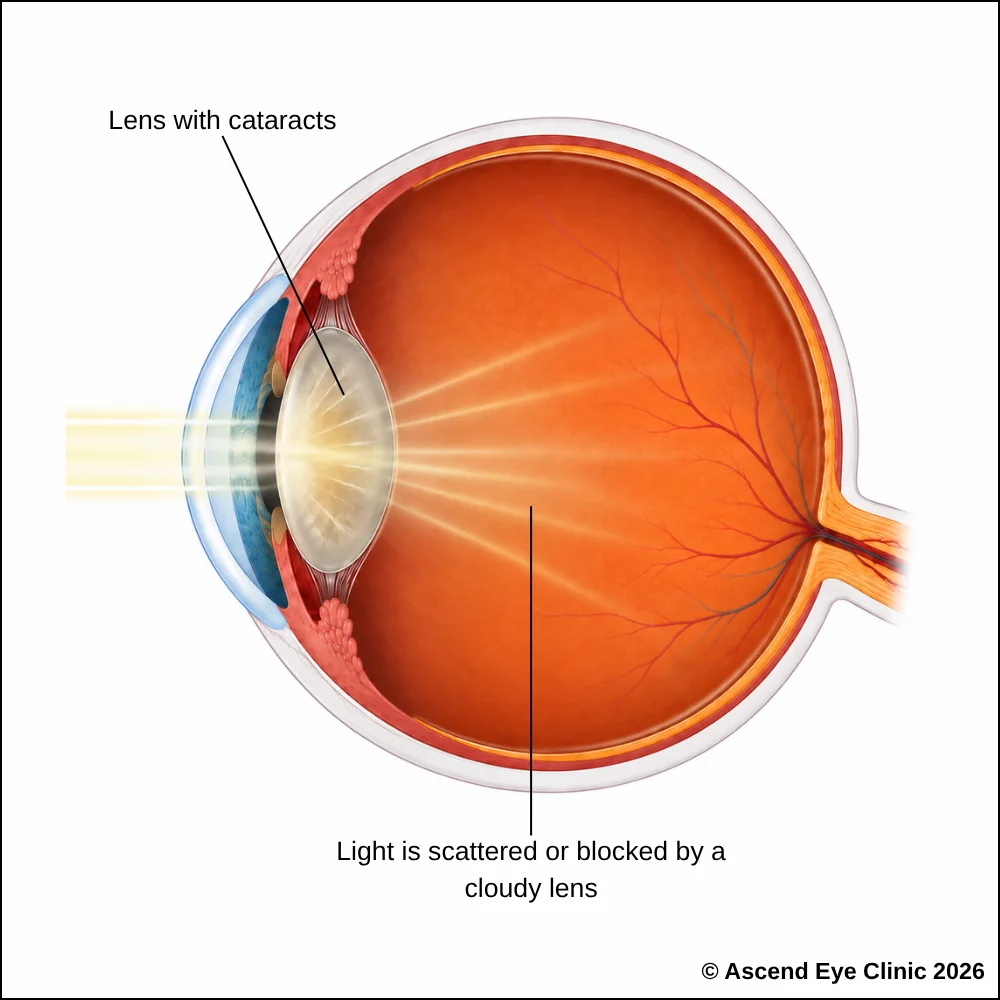
Conventional cataract surgery removes the cloudy natural lens and replaces it with a clear intraocular lens implant. The eye is first numbed with local anaesthesia before small incisions are created at the edge of the cornea. The thin capsule surrounding the natural lens is opened, and ultrasound energy is used to break the cataract into small fragments, which are gently removed from the eye.
The selected lens implant is then placed securely inside the remaining capsule. The incisions are self-sealing and do not require stitches. The procedure is performed as day surgery, and prescribed eye drops are used afterwards to support healing. Mild blurring, watering or light sensitivity is expected during the early recovery period as the eye heals and vision gradually settles.
Laser-assisted cataract surgery uses a femtosecond laser to perform selected stages of the procedure. After the eye is numbed with local anaesthesia, the laser is used to create the corneal incisions, make the opening in the lens capsule and soften the cataract before it is removed.
The cataract is then broken up and removed using ultrasound, before the selected lens implant is placed securely inside the remaining capsule. Using the laser to soften the cataract beforehand reduces the amount of ultrasound energy required during this stage of the procedure. The small incisions are generally self-sealing and do not require stitches.
The procedure is performed as day surgery, and prescribed eye drops are used afterwards to support healing. Mild blurring, watering or sensitivity to light is expected during the early recovery period as the eye heals and vision gradually settles.
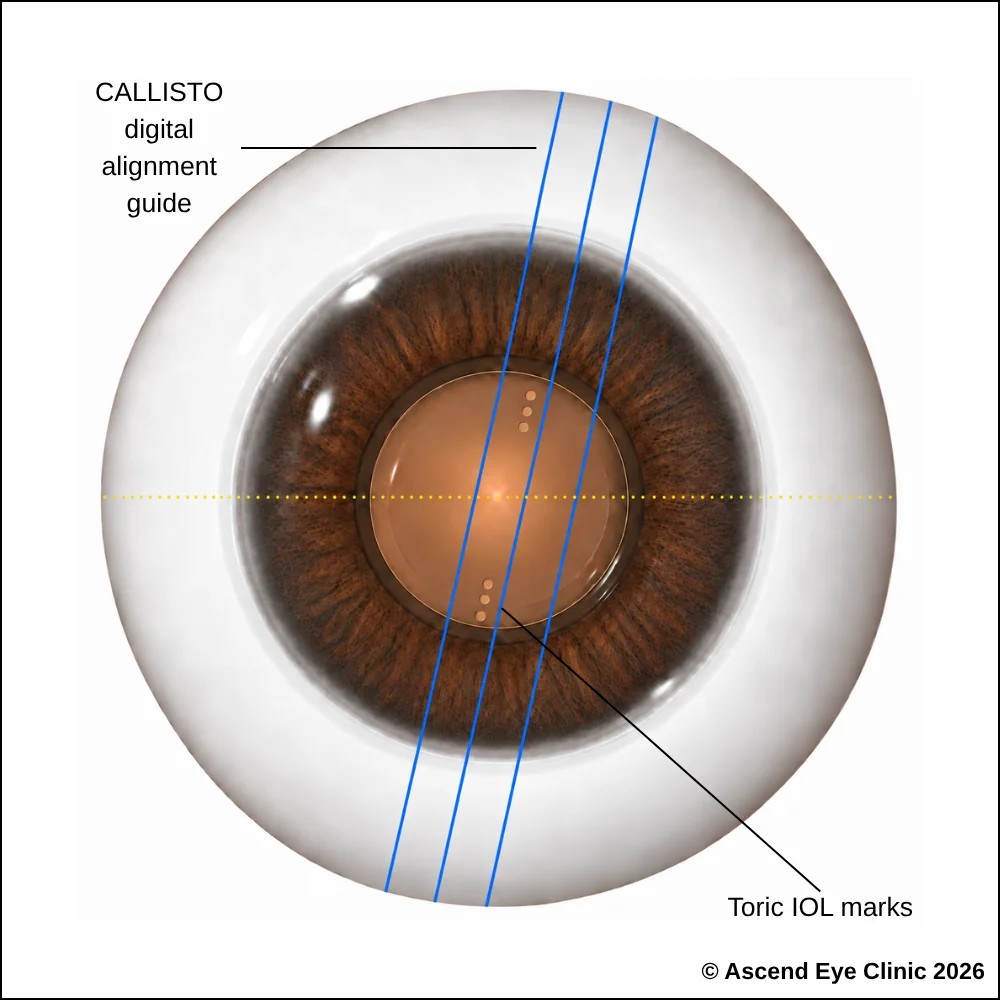
If you have astigmatism, cataract surgery can be planned with a toric lens implant to help correct it. A toric lens has to be positioned at the correct angle inside the eye for it to work as intended, so accurate alignment is an important part of the procedure.
CALLISTO® Digital Guidance helps with this alignment during surgery. The system projects a digital guide into the microscope view, allowing the planned axis to be displayed directly over the eye. This helps the toric lens implant to be positioned more accurately in the intended orientation.
By guiding lens alignment during surgery, the CALLISTO® Digital Guidance system helps reduce reliance on manual marking and supports precise placement of the toric lens implant for astigmatism correction.
Accurate positioning helps optimise the intended visual outcome that is to reduce dependence on glasses after cataract surgery.
Cataract surgery involves replacing the cloudy natural lens with a clear lens implant. Different lens implant options are available to address different visual needs, including:
Lens implant planning does not always follow a one-size-fits-all approach. Different types of lens implants can be selected for each eye to achieve a more personalised balance of distance, intermediate and near vision. This tailored approach optimises the activities and visual demands that matter most to each individual.

From your initial consultation to treatment and follow-up care, our team will guide you through every stage of your journey. We will take the time to explain your condition, answer your questions and help you feel informed and supported throughout your care.

Your consultation begins with a detailed assessment of your vision and eye health. Depending on your condition, this may include measurements of your vision and eye pressure, examination of the front and back of the eye, and advanced diagnostic imaging.
Our team will guide you through each test and explain what is being assessed. Your results will then be carefully reviewed to understand your individual needs and determine whether monitoring or treatment may be recommended.
Every eye and every patient is different. Your treatment plan will be tailored according to your examination findings, visual needs, general health and lifestyle.
We will explain the recommended treatment, its expected benefits, possible risks and any suitable alternatives in a clear and straightforward manner. You will have time to ask questions and consider your options before deciding how you would like to proceed.
Before your treatment, our team will guide you through the necessary preparations, paperwork and medication instructions. Where applicable, we will explain how to use your prescribed eye drops and how to care for your eyes afterwards.
We understand that undergoing a procedure can feel unfamiliar or worrying. Our team will be available to answer your questions and ensure that you know what to expect before the day of your treatment.
On the day of your procedure, you will arrive at the hospital or surgical centre where your operation has been scheduled. The surgical team will help you prepare and explain what will happen at each stage.
Anaesthetic eye drops or other forms of anaesthesia may be used, depending on the procedure, to keep you comfortable. Your doctor and the surgical team will support and reassure you throughout the operation.
Most eye surgeries are performed as day procedures, although the duration and recovery process will depend on the treatment you receive. Your vision may be temporarily blurred afterwards, so you should arrange for someone to accompany you home and should not drive unless your doctor has advised that it is safe to do so.
We will provide clear instructions on how to care for your eyes, use any prescribed medication and manage your activities during recovery. We will also explain which symptoms are expected and when you should contact the clinic for further advice.
Follow-up appointments allow us to monitor your vision, assess your recovery and identify any concerns at an early stage. Our team remains accessible should you have any questions or concerns throughout your recovery.
Whether you undergo conventional or laser-assisted cataract surgery, our focus remains the same: delivering safe, precise, and personalised care. Following a comprehensive assessment, we will recommend the surgical technique and intraocular lens combination that is best suited to your eyes, helping you achieve the best possible visual outcome.
Ready to take the next step? Book a consultation with us to discuss your treatment options and receive a personalised assessment tailored to your vision needs.
Cataract surgery is generally considered when the cataract begins to interfere with everyday activities such as reading, driving, working or recognising faces. There is no single level of vision at which everyone needs surgery. The decision depends on how much the cataract is affecting your vision, lifestyle and daily activities.
No. Cataracts do not need to become very advanced before they can be removed. Surgery can be considered once the cataract is causing meaningful visual difficulties and the expected benefits of treatment outweigh the risks.
Dense or very hard cataracts can require more energy to break up and remove during surgery. We are experienced in managing the full range of cataracts, including advanced and complex cases, and the surgical approach is tailored according to the individual eye.
In selected cases, femtosecond laser-assisted cataract surgery (FLACS) can be used to pre-fragment the cataract before it is removed. By breaking the cataract into smaller pieces with the laser, less ultrasound energy may be required during phacoemulsification, helping to minimise the impact of ultrasound energy on surrounding tissues within the eye.
The eye is numbed with anaesthetic before surgery, and most patients experience little or no pain during the procedure. You may notice bright lights, movement or some pressure while the surgery is being performed.
Yes, cataract surgery is usually performed under local anaesthesia, so you remain awake while the eye is numbed. Sedation may also be given where appropriate to help you remain comfortable and relaxed.
The surgery itself is usually relatively quick, although the total time spent at the surgical centre will be longer to allow for preparation before surgery and observation afterwards. More complex cataracts or combined procedures may take longer.
A small incision is made in the eye and the cloudy natural lens is broken into smaller pieces and removed. A clear intraocular lens implant is then placed inside the eye to replace the focusing power of the natural lens.
The choice of lens implant depends on your eye measurements, astigmatism, retinal and optic nerve health, previous eye surgery and how you would like to use your vision after surgery. Options include monofocal, monofocal plus, extended depth of focus (EDOF) and multifocal lenses, with toric versions available for patients who also require astigmatism correction.
Yes. If you have corneal astigmatism, a toric lens implant can be used to correct it during cataract surgery. Toric versions are available across the different lens categories we offer, allowing astigmatism correction to be incorporated into the selected visual strategy.
Yes. The degree to which glasses can be reduced depends on the lens implant selected, the visual targets planned for each eye and the health of the eye. Monofocal plus, EDOF and multifocal lenses can provide a greater range of vision than a conventional monofocal lens, although no lens implant can guarantee complete freedom from glasses.
Yes. Lens implant planning does not have to follow a one-size-fits-all approach. Different lens types or visual targets can be selected for each eye in suitable patients to create a more personalised balance of distance, intermediate and near vision.
Yes. Previous laser vision correction does not prevent you from having cataract surgery. However, calculating the appropriate lens implant power can be more complex after refractive surgery, so additional measurements and careful pre-operative planning may be required.
Yes. In suitable patients, cataract surgery can be combined with treatment for another eye condition during the same operation.
For patients with glaucoma, cataract surgery may be combined with minimally invasive glaucoma surgery (MIGS). MIGS procedures use small implants or surgical techniques to improve drainage of fluid from the eye, helping to lower eye pressure and potentially reduce reliance on glaucoma medications.
Cataract surgery can also be combined with a vitrectomy when surgery is required for conditions affecting the vitreous or retina, such as an epiretinal membrane, macular hole, vitreous haemorrhage or retinal detachment. In selected cases, performing both procedures together allows the cataract and retinal condition to be addressed during a single operation.
Yes. Many patients with glaucoma can undergo cataract surgery. The surgical plan takes into account the type and severity of glaucoma, current eye pressure, medications and any previous glaucoma treatment. In suitable cases, glaucoma surgery can also be performed at the same time.
Yes, although the final visual outcome will depend on both the cataract and the underlying health of the retina. Removing the cataract can improve the portion of vision being affected by the cloudy lens, but it cannot reverse vision loss caused by retinal disease. The retina is therefore assessed as part of planning for surgery.
Cataract surgery is generally a safe and well-established procedure, but as with any operation, complications can occur. Recognised complications include inflammation, infection, changes in eye pressure, corneal or retinal swelling, retinal detachment and problems involving the capsule that supports the lens implant.
One recognised risk is a tear in the lens capsule. If this occurs, part of the cataract may occasionally move into the vitreous cavity at the back of the eye. These lens fragments can be retrieved with a vitrectomy where required. If the remaining capsule cannot safely support the originally planned lens, an alternative method of lens implantation may be used to provide appropriate visual correction.
The lens implant is usually positioned within the natural capsular bag that previously contained the cataract. If the capsule or its supporting structures are not sufficiently stable, the surgical plan can be modified and an alternative lens implant or method of fixation can be used. The priority is to achieve a stable and appropriately supported lens implant.
Vision often begins improving soon after surgery, but some initial blur is normal while the eye heals. The rate of improvement differs between patients and may be influenced by the density of the cataract, the complexity of surgery and any other conditions affecting the eye.
This depends on the type of lens implant selected and the visual targets chosen before surgery. Some patients may use glasses only for certain activities, while others may remain more dependent on them. Your expected range of vision and likely need for glasses will be discussed during lens planning.
Many patients are able to resume light everyday activities relatively quickly, although the eye continues to heal over the following weeks. Recovery can vary depending on the individual eye and whether cataract surgery was performed alone or together with another procedure.
You should not drive immediately after surgery. Driving can resume once your vision has recovered sufficiently to meet the required visual standard and your doctor has advised that it is safe to do so.
Yes. Eye drops are usually prescribed after surgery to control inflammation and support healing. The type of drops, frequency and duration will depend on your eye and post-operative recovery.
No. Once the natural lens has been removed, the cataract itself cannot return. However, the thin capsule behind the lens implant can become cloudy months or years later. This is known as posterior capsular opacification (PCO) and can cause vision to become hazy again.
If the cloudiness is caused by posterior capsular opacification, it can usually be treated with a short YAG laser capsulotomy. The laser creates a clear opening in the cloudy capsule behind the lens implant, allowing light to pass through clearly again.
Some temporary blur, irritation or mild discomfort can occur during the early recovery period. However, sudden or worsening vision loss, significant pain, increasing redness, new flashes, a sudden increase in floaters or a dark curtain or shadow in the vision should be assessed promptly, as these can occasionally indicate a complication requiring treatment.
Hi, I would like to book a consultation with Dr Errol Chan from Ascend Eye Clinic
