
Correct cataracts and astigmatism together for sharper, clearer vision.
Astigmatism is a common refractive error caused by an irregular curvature of the cornea. Instead of focusing light at a single point on the retina, the eye forms multiple focal points, resulting in blurred or distorted vision.
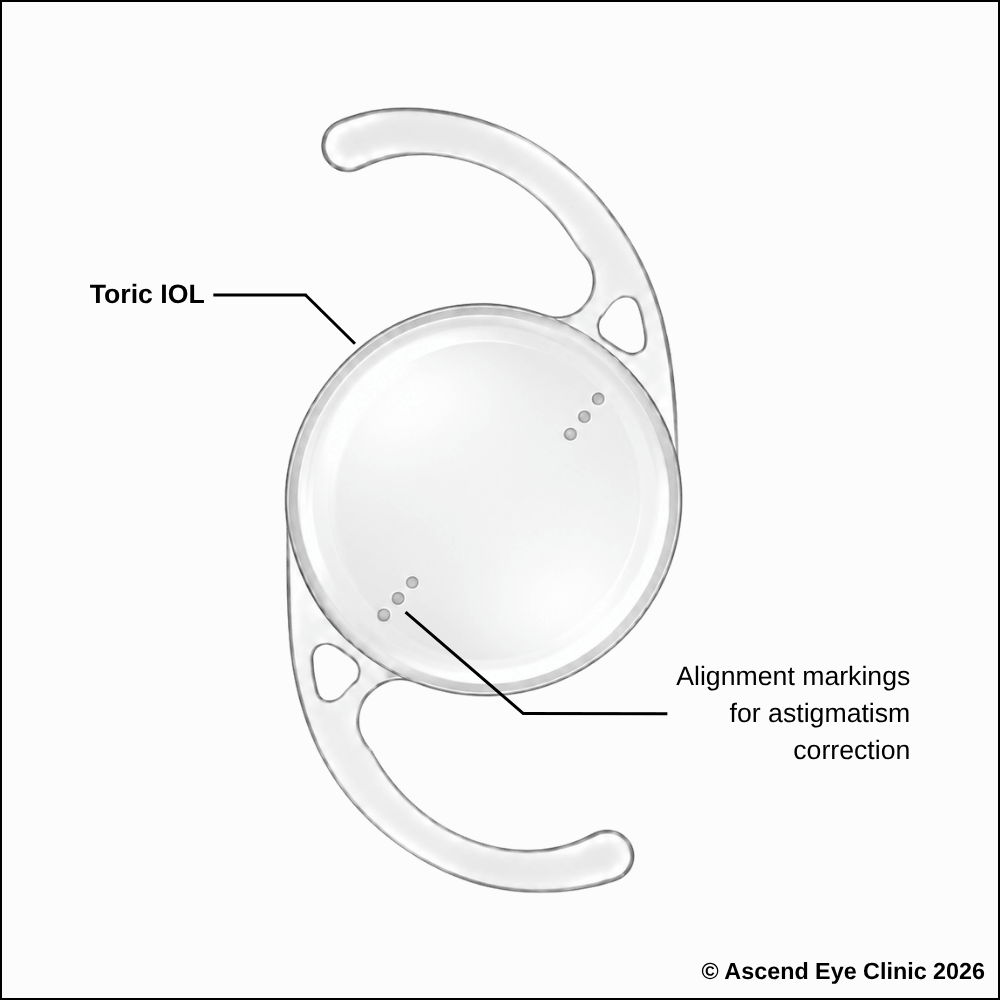
A toric lens implant is designed for cataract patients who also have astigmatism. It corrects both the cataract and astigmatism during the same procedure. A toric lens implant compensates for this irregular curvature, providing sharper and clearer vision while reducing dependence on glasses compared with a standard monofocal lens implant that does not correct astigmatism.
Before surgery, detailed measurements of the eye are taken to determine the amount and direction of astigmatism, as well as the correct lens implant power.
The toric lens implant contains built-in astigmatism correction and must be positioned at a precise angle inside the eye. During surgery, advanced imaging and guidance technology helps us align the toric lens implant along the exact axis required to correct the astigmatism. This supports accurate and consistent visual correction.
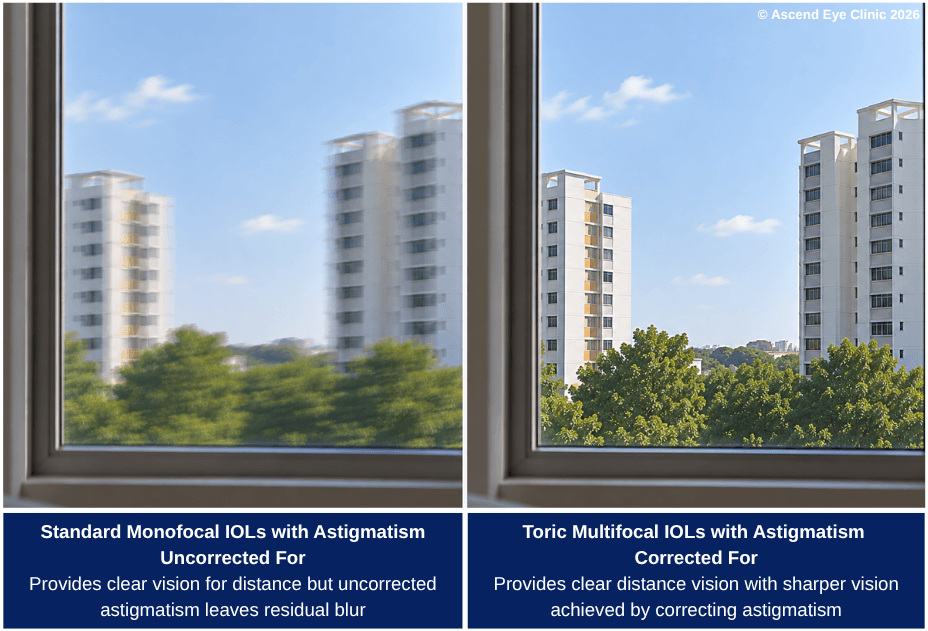
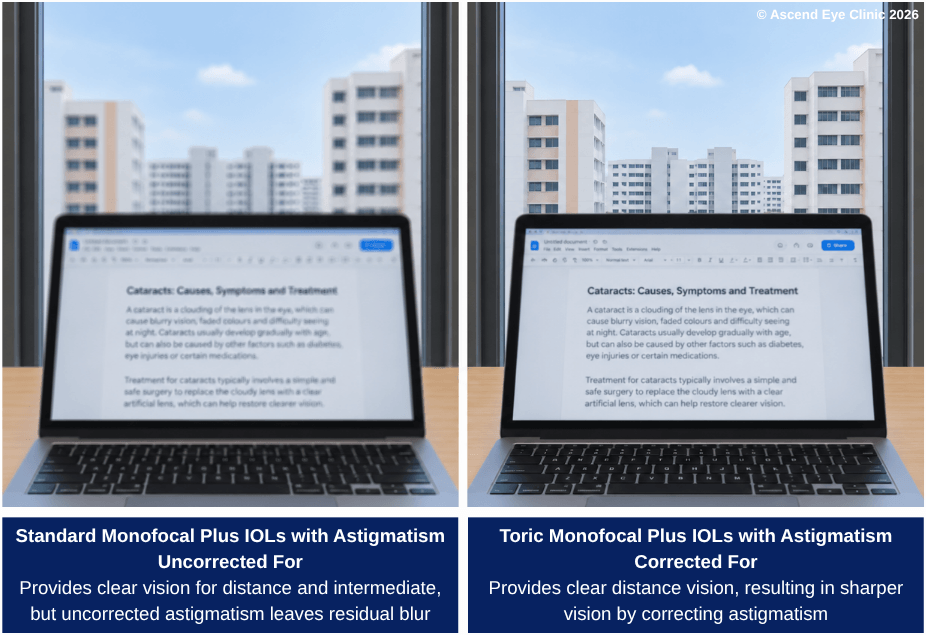
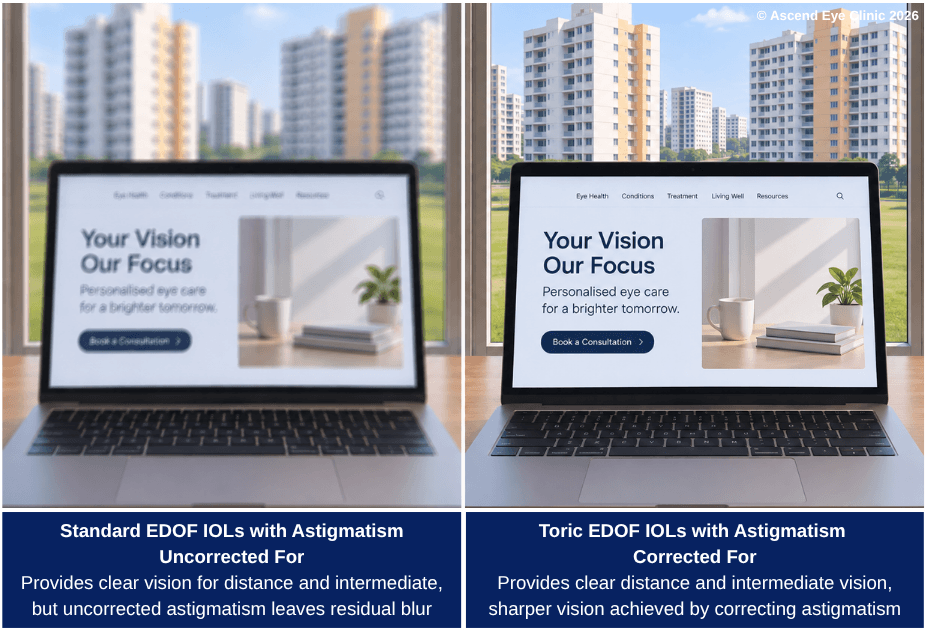
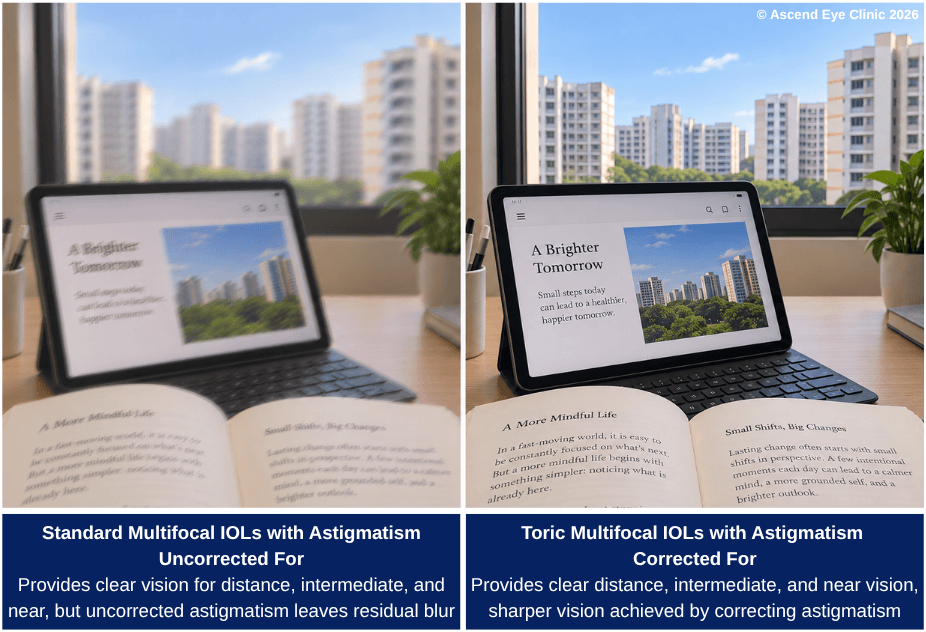
You can expect sharper and clearer vision with less blur or distortion caused by astigmatism. Your dependence on glasses after surgery depends on the type of toric lens implant selected and the visual target planned for your eye.
Toric lens implantation is performed as part of standard cataract surgery and does not require a separate procedure or a longer recovery period.

Toric lens implants are chosen by people who want to correct both cataracts and astigmatism during the same operation. Correcting astigmatism at the time of cataract surgery provides clearer vision and reduces reliance on glasses compared with leaving the astigmatism untreated.
Detailed measurements and precise alignment allow the correction to be tailored to the shape of your cornea.
The same lens implant does not always need to be used in both eyes. In selected patients, different lens implant technologies may be chosen for each eye to create a more personalised balance of distance, intermediate and near vision.
For example, one eye may be optimised more strongly for distance vision, while the other provides greater support for intermediate or near tasks. This customised approach takes into account factors such as eye dominance, existing astigmatism, visual requirements and lifestyle.
Detailed measurements and discussion of visual priorities help determine whether using different lens implants between the two eyes may provide a better overall visual outcome.

From your initial consultation to treatment and follow-up care, our team will guide you through every stage of your journey. We will take the time to explain your condition, answer your questions and help you feel informed and supported throughout your care.

Your consultation begins with a detailed assessment of your vision and eye health. Depending on your condition, this may include measurements of your vision and eye pressure, examination of the front and back of the eye, and advanced diagnostic imaging.
Our team will guide you through each test and explain what is being assessed. Your results will then be carefully reviewed to understand your individual needs and determine whether monitoring or treatment may be recommended.
Every eye and every patient is different. Your treatment plan will be tailored according to your examination findings, visual needs, general health and lifestyle.
We will explain the recommended treatment, its expected benefits, possible risks and any suitable alternatives in a clear and straightforward manner. You will have time to ask questions and consider your options before deciding how you would like to proceed.
Before your treatment, our team will guide you through the necessary preparations, paperwork and medication instructions. Where applicable, we will explain how to use your prescribed eye drops and how to care for your eyes afterwards.
We understand that undergoing a procedure can feel unfamiliar or worrying. Our team will be available to answer your questions and ensure that you know what to expect before the day of your treatment.
On the day of your procedure, you will arrive at the hospital or surgical centre where your operation has been scheduled. The surgical team will help you prepare and explain what will happen at each stage.
Anaesthetic eye drops or other forms of anaesthesia may be used, depending on the procedure, to keep you comfortable. Your doctor and the surgical team will support and reassure you throughout the operation.
Most eye surgeries are performed as day procedures, although the duration and recovery process will depend on the treatment you receive. Your vision may be temporarily blurred afterwards, so you should arrange for someone to accompany you home and should not drive unless your doctor has advised that it is safe to do so.
We will provide clear instructions on how to care for your eyes, use any prescribed medication and manage your activities during recovery. We will also explain which symptoms are expected and when you should contact the clinic for further advice.
Follow-up appointments allow us to monitor your vision, assess your recovery and identify any concerns at an early stage. Our team remains accessible should you have any questions or concerns throughout your recovery.
If you have astigmatism, a toric lens can correct it at the time of cataract surgery, helping you achieve clearer vision and reducing your dependence on glasses. We use detailed eye measurements to determine whether a toric lens is appropriate for you.
Arrange a consultation to discuss whether a toric lens can help you achieve your best possible vision.
Not necessarily. The astigmatism shown in a glasses prescription reflects the overall focusing error of the eye, while selection of a toric lens is based mainly on the amount and pattern of corneal astigmatism expected to remain after surgery. Detailed measurements are therefore required before deciding whether a toric lens is appropriate.
We will measure the curvature and shape of the cornea and assess how much astigmatism needs to be corrected. These measurements are combined with the other calculations required for the lens implant to determine whether a toric lens will provide useful correction.
A standard non-toric lens does not directly correct pre-existing corneal astigmatism. If significant astigmatism remains after surgery, vision can still appear blurred without glasses even when the lens implant power is otherwise accurate.
A toric lens is selected to reduce the astigmatism as accurately as possible, but a small residual amount can remain after surgery. The final result depends on the eye measurements, the available lens powers and how the eye heals.
Yes. The overall power of the lens implant is calculated to address the eye’s focusing prescription, while the toric component is specifically designed to correct corneal astigmatism.
That depends on the type of toric lens selected and the visual target planned for each eye. A toric lens reduces astigmatism and can reduce dependence on glasses, but it does not guarantee complete freedom from glasses for every distance.
Not every amount of astigmatism requires a toric lens. We will consider how much astigmatism is present, how much is expected to remain after surgery and whether correcting it is likely to make a meaningful difference to your unaided vision.
Toric lenses are available in different astigmatism-correcting powers, including options for higher levels of corneal astigmatism. The appropriate range depends on the measurements of the eye and the toric lens model being considered.
Your glasses prescription measures the combined focusing error of the entire eye. For a toric lens implant, we also need to measure the astigmatism arising specifically from the cornea, so the numbers do not always match exactly.
Toric lens calculations depend on accurate assessment of the amount and direction of corneal astigmatism. Using several measurements allows us to check that the readings are reliable and plan the correction more precisely.
We will repeat the measurements and look for factors affecting their reliability before finalising the lens choice. The aim is to use stable and consistent measurements rather than selecting a toric lens from a single reading that does not agree with the rest of the assessment.
Yes. An unstable tear film can alter measurements taken from the surface of the cornea. If this is affecting the readings, the ocular surface needs to be addressed and the measurements repeated before the final lens calculation.
Correcting significant corneal astigmatism allows light to focus more accurately on the retina and improves unaided image clarity. Toric lenses are specifically designed to provide better uncorrected vision by reducing this astigmatic blur.
Yes, when the blur is caused by astigmatism. Astigmatism prevents light from forming a single sharp focus, so reducing it can make edges, letters and fine details appear more clearly defined.
Blurred vision after surgery does not automatically mean that the toric lens has failed to correct the astigmatism. We will assess the remaining prescription, cornea, tear film, retina and lens implant to identify the cause and determine whether any further treatment is required.
Yes. Each eye is planned individually. If one eye has enough corneal astigmatism to benefit from a toric lens while the other does not, different lens designs can be selected for each eye.
Yes. Toric correction is available with different types of lens implants, including designs intended to extend vision beyond distance. The visual range therefore depends on the underlying lens design selected, while the toric component corrects astigmatism.
Previous laser vision correction does not automatically rule out a toric lens. Because laser treatment changes the shape of the cornea, additional measurements and careful calculations are required to determine the appropriate lens power and astigmatism correction.
It depends on the shape and stability of the cornea. Toric lenses work most predictably when the astigmatism is sufficiently regular and measurements are stable. More detailed corneal assessment is therefore required in eyes with keratoconus or other conditions that alter corneal shape.
The astigmatism correction built into the lens implant does not wear off. However, the cornea and other parts of the eye can change over time, so the amount of astigmatism measured later in life can differ from the amount present at the time of surgery.
Hi, I would like to book a consultation with Dr Errol Chan from Ascend Eye Clinic
