
For persistent floaters that significantly interfere with vision or daily activities, a floater vitrectomy removes the vitreous gel containing the opacities responsible for these visual disturbances. Treatment is recommended after a detailed retinal assessment and we plan treatment according to your symptoms, eye health and visual needs.
Vitreous floaters are small strands, clumps or opacities that form within the vitreous, the clear gel that fills the inside of the eye. As the vitreous naturally changes with age, it becomes more liquefied and the collagen fibres within it can condense or clump together. These opacities cast shadows onto the retina, which are seen as spots, lines, cobwebs or drifting shapes in the vision.
For most people, floaters are mild and become less noticeable over time. However, bothersome floaters can appear as persistent dark spots, strands, clouds or cobweb-like shadows that move across the vision, particularly against bright backgrounds such as a computer screen, white wall or clear sky. Dense or numerous floaters can obscure parts of the vision, interfere with reading, and make tasks such as driving or working on a computer more difficult.
When floaters remain persistent and significantly affect daily activities, a vitrectomy is performed to remove the vitreous gel containing the floaters and reduce the visual disturbance.

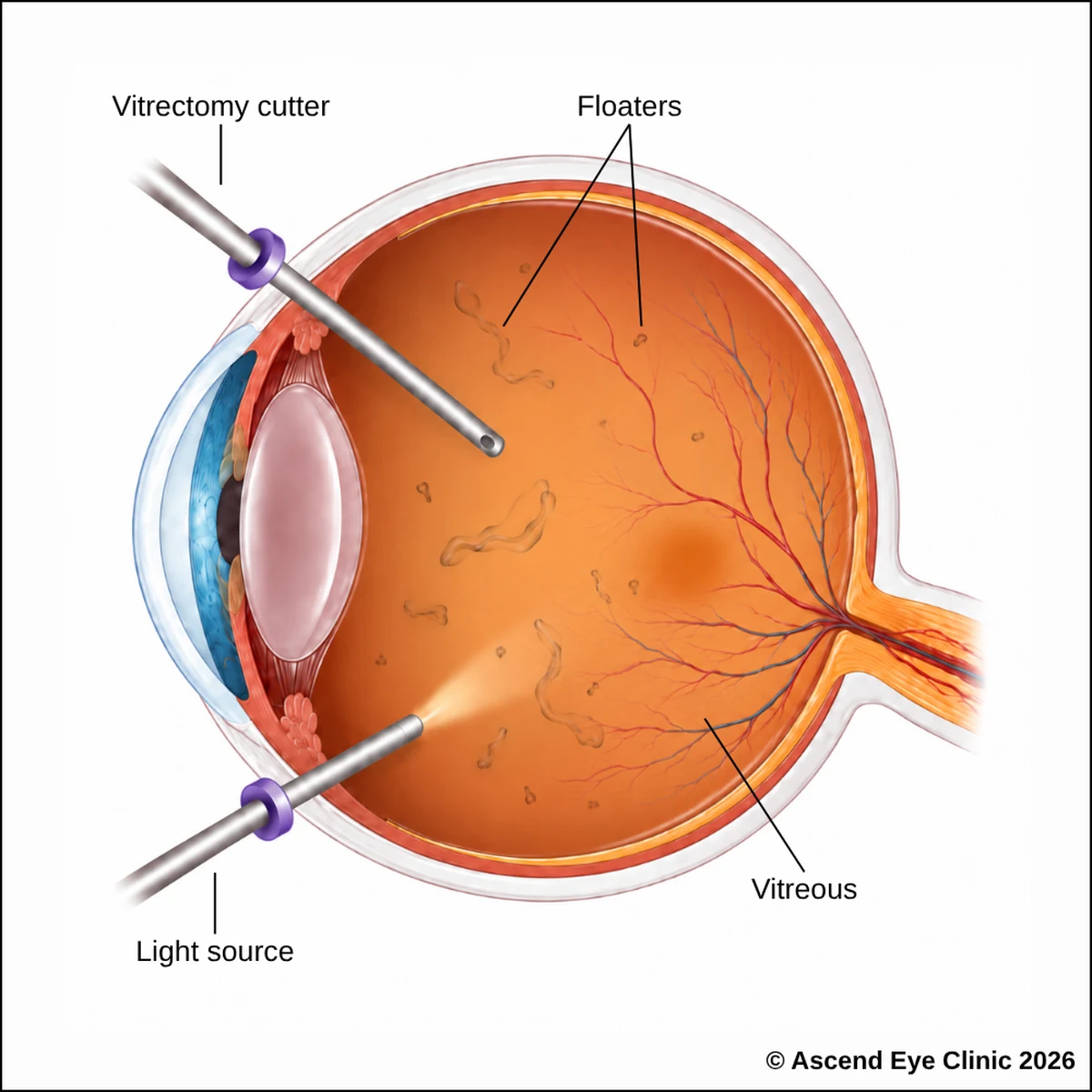
A vitrectomy is used to treat persistent vitreous floaters that significantly interfere with vision or daily activities. The procedure removes the vitreous gel containing the strands, clumps or opacities responsible for the floaters, preventing them casting shadows onto the retina.
The procedure is performed in an operating theatre and typically takes around 15 to 20 minutes. Fine instruments are introduced through small ports in the white part of the eye, and the vitreous gel is removed alongside the visually significant opacities while examining the retina throughout the procedure.
Once the vitreous has been removed, the space inside the eye is naturally replaced by clear fluid produced by the eye. Unlike other vitrectomies a gas bubble is generally not required when surgery is performed solely for vitreous floaters.
Vision is blurred initially and improves as the eye heals, with most of the troublesome floaters removed during surgery. Follow-up is required to monitor healing, eye pressure and the retina after the procedure.
From your initial consultation to treatment and follow-up care, our team will guide you through every stage of your journey. We will take the time to explain your condition, answer your questions and help you feel informed and supported throughout your care.
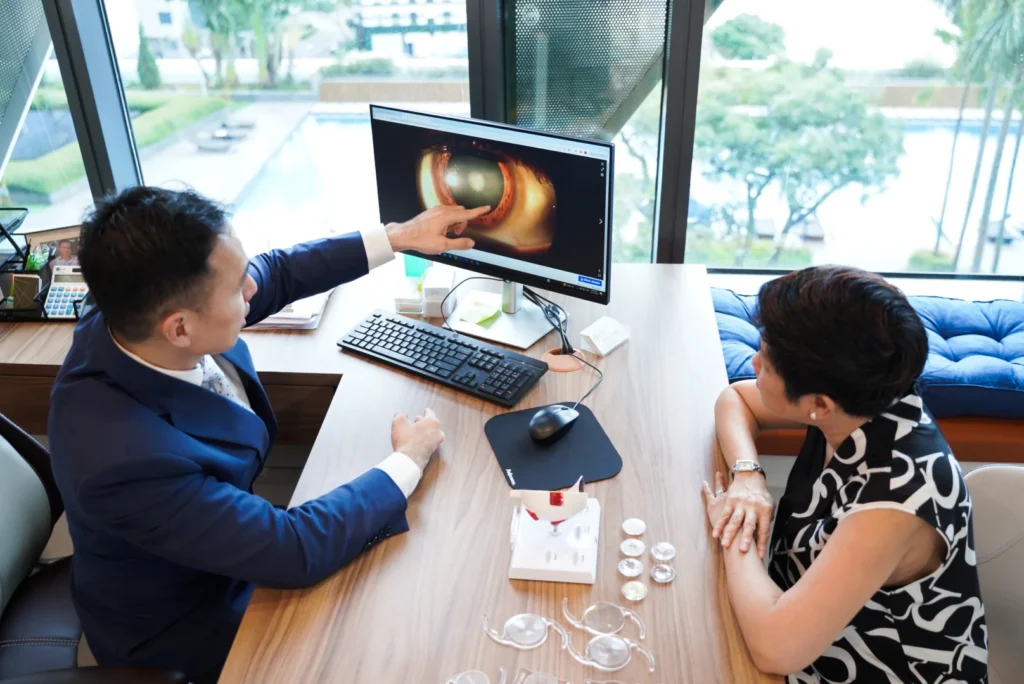
Your consultation begins with a detailed assessment of your vision and eye health. Depending on your condition, this may include measurements of your vision and eye pressure, examination of the front and back of the eye, and advanced diagnostic imaging.
Our team will guide you through each test and explain what is being assessed. Your results will then be carefully reviewed to understand your individual needs and determine whether monitoring or treatment may be recommended.
Every eye and every patient is different. Your treatment plan will be tailored according to your examination findings, visual needs, general health and lifestyle.
We will explain the recommended treatment, its expected benefits, possible risks and any suitable alternatives in a clear and straightforward manner. You will have time to ask questions and consider your options before deciding how you would like to proceed.
Before your treatment, our team will guide you through the necessary preparations, paperwork and medication instructions. Where applicable, we will explain how to use your prescribed eye drops and how to care for your eyes afterwards.
We understand that undergoing a procedure can feel unfamiliar or worrying. Our team will be available to answer your questions and ensure that you know what to expect before the day of your treatment.
On the day of your procedure, you will arrive at the hospital or surgical centre where your operation has been scheduled. The surgical team will help you prepare and explain what will happen at each stage.
Anaesthetic eye drops or other forms of anaesthesia may be used, depending on the procedure, to keep you comfortable. Your doctor and the surgical team will support and reassure you throughout the operation.
Most eye surgeries are performed as day procedures, although the duration and recovery process will depend on the treatment you receive. Your vision may be temporarily blurred afterwards, so you should arrange for someone to accompany you home and should not drive unless your doctor has advised that it is safe to do so.
We will provide clear instructions on how to care for your eyes, use any prescribed medication and manage your activities during recovery. We will also explain which symptoms are expected and when you should contact the clinic for further advice.
Follow-up appointments allow us to monitor your vision, assess your recovery and identify any concerns at an early stage. Our team remains accessible should you have any questions or concerns throughout your recovery.
If persistent floaters are interfering with reading, driving or everyday vision, vitrectomy can remove the vitreous opacities responsible for these visual disturbances. Book a consultation to assess your floaters and determine whether surgical treatment is suitable for your eyes.
Surgery is considered when floaters are persistent, prominent and interfere with daily activities such as reading, driving, working on screens or seeing clearly in bright environments. We first assess the vitreous and retina carefully to confirm that the symptoms are caused by vitreous opacities and that surgery is appropriate.
Floater surgery is performed with a vitrectomy. Fine instruments are introduced through small openings in the white part of the eye, and the vitreous gel containing the strands, clumps or opacities responsible for the floaters is removed. The aim is to clear the visual axis and reduce the shadows being cast onto the retina.
The surgery removes the vitreous opacities responsible for the troublesome floaters. The aim is to achieve a much clearer field of vision, although tiny residual opacities can remain and new visual phenomena can still occur over time.
Anaesthesia is used to keep the eye comfortable throughout the procedure. Floater surgery is commonly performed under local anaesthesia with sedation. Mild soreness, irritation or a gritty sensation can occur during the early recovery period.
Yes. Most floater surgery is performed under local anaesthesia with sedation, so you remain awake but relaxed and comfortable. We will guide you throughout the procedure and make sure you are comfortable before surgery begins.
The operation is generally completed within a relatively short surgical session of around 15 to 20 minutes. The exact duration depends on the condition of the vitreous and whether any additional retinal treatment is required during surgery.
Floater surgery is performed as day surgery. You will rest and be observed after the procedure before returning home. An overnight stay is not required unless there is a specific medical reason.
Vision is blurred immediately after surgery and clears progressively as the eye settles. Once the postoperative blur improves, the shadows, strands and moving opacities caused by the treated floaters should be significantly reduced.
The eye settles over several weeks. Vision improves progressively during this period as inflammation reduces and the eye heals. We will monitor your recovery at follow-up visits and let you know when you can return to each activity.
The vitreous opacities removed during surgery do not return. New visual disturbances can still develop later from changes elsewhere in the eye, but the treated vitreous floaters themselves have been physically removed.
A gas bubble is not routinely required for straightforward floater surgery. It is used only when additional retinal treatment is needed during the operation. We will explain this clearly if it becomes relevant to your surgery.
Avoid rubbing the eye, swimming, strenuous exercise and heavy lifting during the early recovery period. Keep water, dust and other contaminants away from the eye while it heals. We will provide clear postoperative instructions before you leave.
Light daily activities can be resumed early in the recovery period. Return to work depends on how quickly your vision clears and the type of work you do. Strenuous exercise, heavy lifting and swimming require a longer break while the eye heals.
As with any vitrectomy, risks include infection, bleeding, retinal tears, retinal detachment, changes in eye pressure and cataract formation. These complications are uncommon, but they are important to understand before deciding on surgery. We will discuss the risks in relation to your eye and your symptoms.
Contact us promptly if you develop increasing eye pain, worsening redness, a sudden drop in vision, a new dark shadow or curtain, a sudden increase in flashes or floaters, or increasing discharge. These symptoms need early assessment to make sure the eye is healing properly.
Hi, I would like to book a consultation with Dr Errol Chan from Ascend Eye Clinic
