
Using YAG laser technology, clouding that develops behind a lens after cataract surgery is gently cleared, helping restore clear vision through a quick and comfortable procedure.
Posterior Capsular Opacification (PCO) is a common issue that can happen months or even years after cataract surgery. During cataract surgery, the cloudy lens inside your eye is removed, but a thin, clear layer behind it is left in place to hold your new artificial lens. Over time, this layer can become cloudy, causing your vision to blur again. It’s often called a “secondary cataract,” though it isn’t actually a cataract coming back, but rather a separate change that can happen after surgery.
Common signs of PCO include blurry or hazy vision, glare or sensitivity to light, and trouble seeing in dim lighting, similar to what you may have experienced before your original cataract surgery. If your vision starts to cloud again after previously seeing clearly following cataract surgery, it’s worth getting your eyes checked.
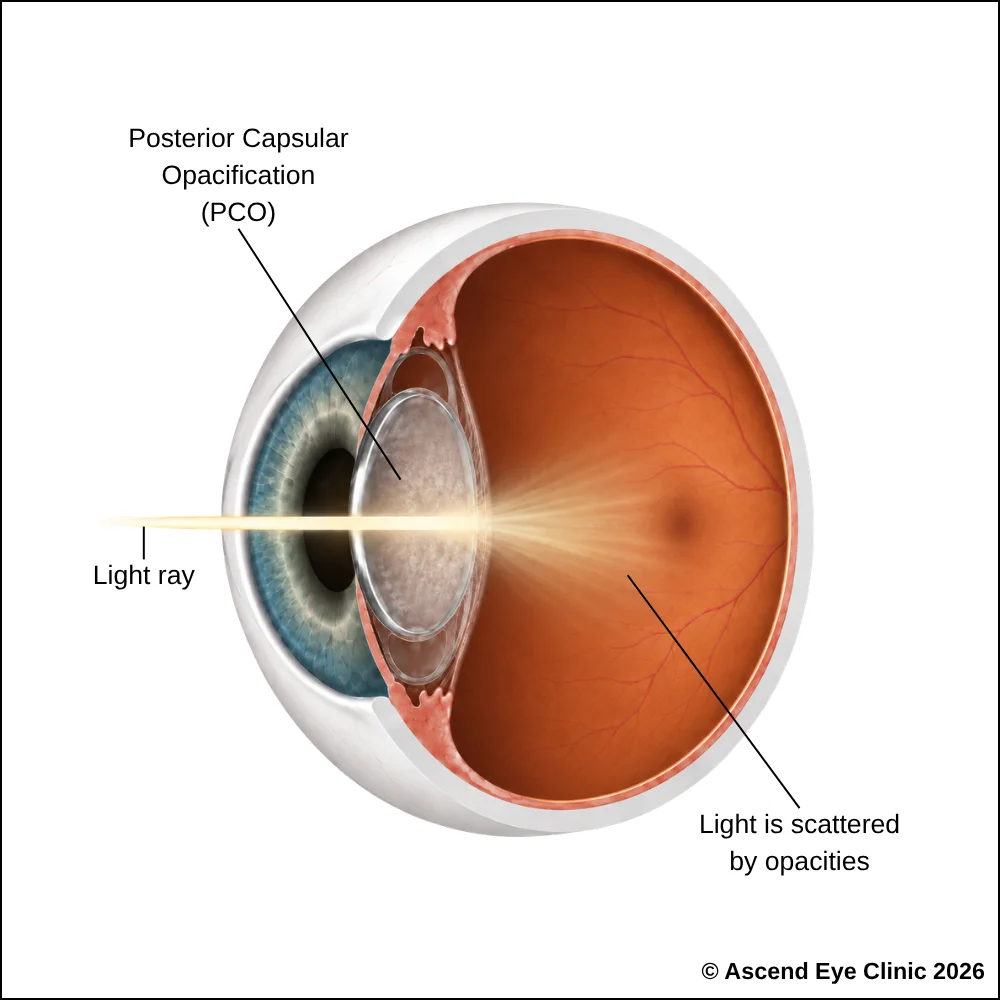
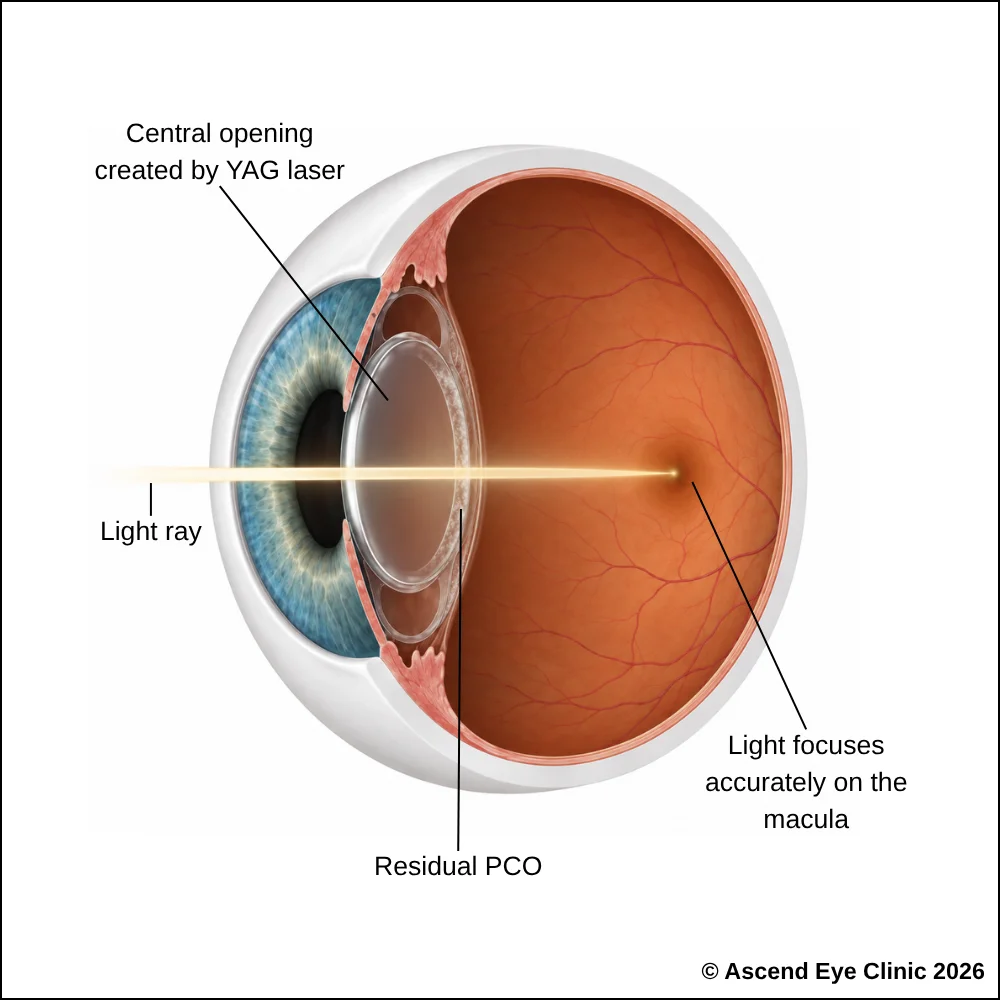
YAG laser capsulotomy is a quick, painless treatment for PCO. A laser is used to create a small opening in the cloudy layer, letting light pass through clearly again so your vision improves. It’s done in the clinic, doesn’t involve any cuts, and usually takes just a few minutes.
Before the treatment, eye drops are used to widen your pupil and prepare your eye. The procedure is performed in a laser treatment room as an outpatient treatment, so no hospitalisation is required. You will sit at a machine similar to those used during eye examinations, and the laser is directed through the front of the eye without touching it. Most people feel little to no discomfort during the procedure.
From your initial consultation to treatment and follow-up care, our team will guide you through every stage of your journey. We will take the time to explain your condition, answer your questions and help you feel informed and supported throughout your care.

Your consultation begins with a detailed assessment of your vision and eye health. Depending on your condition, this may include measurements of your vision and eye pressure, examination of the front and back of the eye, and advanced diagnostic imaging.
Our team will guide you through each test and explain what is being assessed. Your results will then be carefully reviewed to understand your individual needs and determine whether monitoring or treatment may be recommended.
Every eye and every patient is different. Your treatment plan will be tailored according to your examination findings, visual needs, general health and lifestyle.
We will explain the recommended treatment, its expected benefits, possible risks and any suitable alternatives in a clear and straightforward manner. You will have time to ask questions and consider your options before deciding how you would like to proceed.
Before your treatment, our team will guide you through the necessary preparations, paperwork and medication instructions. Where applicable, we will explain how to use your prescribed eye drops and how to care for your eyes afterwards.
We understand that undergoing a procedure can feel unfamiliar or worrying. Our team will be available to answer your questions and ensure that you know what to expect before the day of your treatment.
On the day of your procedure, you will arrive at the hospital or surgical centre where your operation has been scheduled. The surgical team will help you prepare and explain what will happen at each stage.
Anaesthetic eye drops or other forms of anaesthesia may be used, depending on the procedure, to keep you comfortable. Your doctor and the surgical team will support and reassure you throughout the operation.
Most eye surgeries are performed as day procedures, although the duration and recovery process will depend on the treatment you receive. Your vision may be temporarily blurred afterwards, so you should arrange for someone to accompany you home and should not drive unless your doctor has advised that it is safe to do so.
We will provide clear instructions on how to care for your eyes, use any prescribed medication and manage your activities during recovery. We will also explain which symptoms are expected and when you should contact the clinic for further advice.
Follow-up appointments allow us to monitor your vision, assess your recovery and identify any concerns at an early stage. Our team remains accessible should you have any questions or concerns throughout your recovery.
YAG laser treatment is a simple outpatient procedure that can quickly improve vision clouded by PCO.
Arrange a consultation with us to discuss your treatment options.
One possible cause is posterior capsule opacification (PCO). During cataract surgery, the natural lens is removed but the thin capsule that supports the lens implant remains in place. Over time, cells can grow across the back of this capsule and make it cloudy, causing vision to become blurred or hazy again.
PCO can develop months or years after cataract surgery. The timing varies between individuals, so vision can remain clear for a long time before PCO becomes noticeable.
No. PCO is relatively common, but not everyone who undergoes cataract surgery develops it. Many people never require treatment for PCO.
Yes. PCO develops independently in each eye. If cataract surgery has been performed in both eyes, one eye can develop significant PCO while the capsule in the other eye remains clear.
Blurred vision after cataract surgery is not always caused by PCO. We will examine the lens implant and posterior capsule and assess the rest of the eye, including the retina, to determine whether PCO is responsible for the change in vision.
A new glasses prescription will not remove the cloudiness caused by PCO. Glasses correct refractive error, whereas PCO interferes with light passing clearly through the capsule behind the lens implant. If PCO is responsible for reduced vision, YAG laser capsulotomy addresses the cause directly.
PCO can become denser over time, causing increasing blur, glare and reduced contrast. It does not mean that the cataract has returned, but treatment is usually considered once the cloudiness begins to interfere with vision or everyday activities.
Not necessarily. Mild PCO that is not affecting vision does not always require immediate treatment. YAG laser capsulotomy is performed when the PCO is significant enough to interfere with visual clarity, glare, contrast or daily activities.
Yes. PCO does not only reduce visual sharpness. It also scatters light and reduces contrast, which can cause glare, halos around lights and greater difficulty seeing in dim conditions or while driving at night.
Yes. PCO can reduce clarity and contrast with any lens implant. With multifocal and EDOF lenses, even relatively mild capsule clouding can interfere with the optical performance of the implant and become noticeable as reduced clarity, glare or deterioration in the expected range of vision.
If PCO is the main reason the vision has deteriorated, YAG laser treatment is designed to restore the clarity that was lost because of the cloudy capsule. The final vision will still depend on the health of the retina, optic nerve, cornea and other structures within the eye.
The laser itself is generally painless. Anaesthetic eye drops can be used, particularly if a contact lens is placed on the eye to help focus the laser. Bright lights and clicking sounds from the laser are normal during treatment.
The laser treatment itself usually takes around 5 to 10 minutes. The overall visit is longer because the pupils need to be dilated and the eye is assessed before treatment.
Many people notice clearer vision immediately or shortly after treatment. Full visual clarity can take several days as the dilating drops wear off and small particles released from the capsule settle.
It can be. The pupil-dilating drops used before treatment commonly cause temporary blur and light sensitivity, and vision can remain slightly hazy immediately after the laser. This usually improves as the drops wear off and the eye settles.
The laser creates an opening in the cloudy capsule, releasing tiny pieces of capsular material into the eye. These can temporarily appear as spots, lines or cobweb-like floaters. They usually become much less noticeable over the following days or weeks.
YAG laser capsulotomy is generally a safe procedure. Possible effects include a temporary rise in eye pressure, inflammation, floaters and small laser marks on the lens implant. Less common but more significant risks include swelling at the macula and retinal tears or retinal detachment.
Because YAG laser capsulotomy does not involve an incision or stitches, normal daily activities can usually be resumed shortly after treatment. Driving should be avoided until the pupil dilation has worn off and vision has returned to normal.
The opening created in the cloudy posterior capsule generally remains permanently clear, so PCO does not usually return in the treated central area. YAG laser capsulotomy is therefore normally a one-off treatment.
YAG laser treatment can cause a very small change in the position of the lens implant, but any resulting change in prescription is generally minimal. The lens implant itself remains in the eye and is not removed or replaced during the procedure.
Hi, I would like to book a consultation with Dr Errol Chan from Ascend Eye Clinic
