
Corneal conditions can affect the clarity, comfort and quality of your vision. At Ascend Eye Clinic, we provide comprehensive assessment and tailored treatment to protect the cornea and support clear, comfortable vision.
The cornea is the clear, dome-shaped surface at the front of the eye. It curves over the iris and pupil and helps focus light so you can see clearly. When the cornea becomes damaged, inflamed or cloudy, it can cause discomfort, blurred vision and, in more serious cases, permanent vision loss.
Corneal conditions can affect different layers of the cornea. Many corneal conditions can be successfully managed, particularly when they are detected early. At Ascend Eye Clinic, we provide detailed assessment and personalised care for a range of corneal conditions. The conditions we assess and treat include:
We will explain your diagnosis clearly and recommend the most appropriate treatment to protect your vision and maintain the health of your eyes.
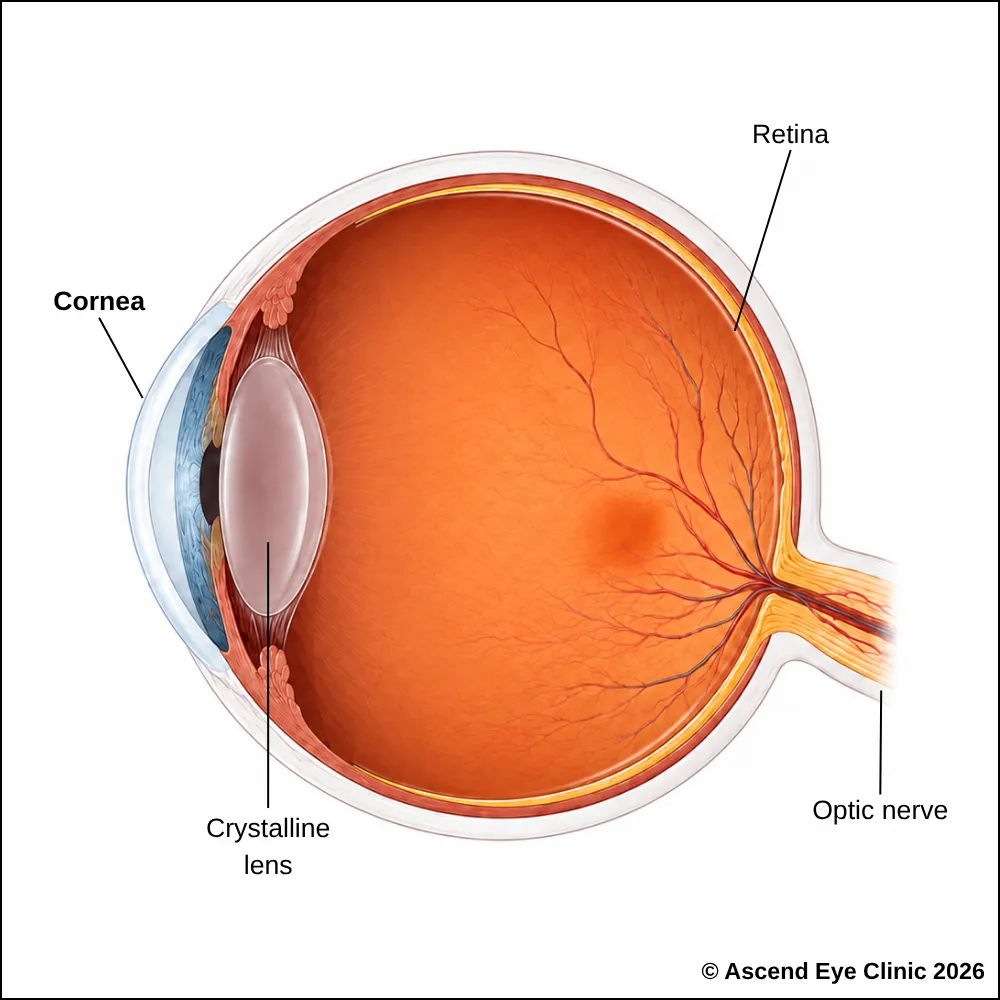
Corneal conditions can affect comfort and vision in different ways. Some develop gradually, while infections or injuries may cause symptoms more suddenly. Common symptoms include:
Some corneal conditions do not cause noticeable symptoms in their early stages. Sudden eye pain, marked redness, light sensitivity or worsening vision should be assessed promptly, as these can indicate a corneal infection or injury requiring early treatment.

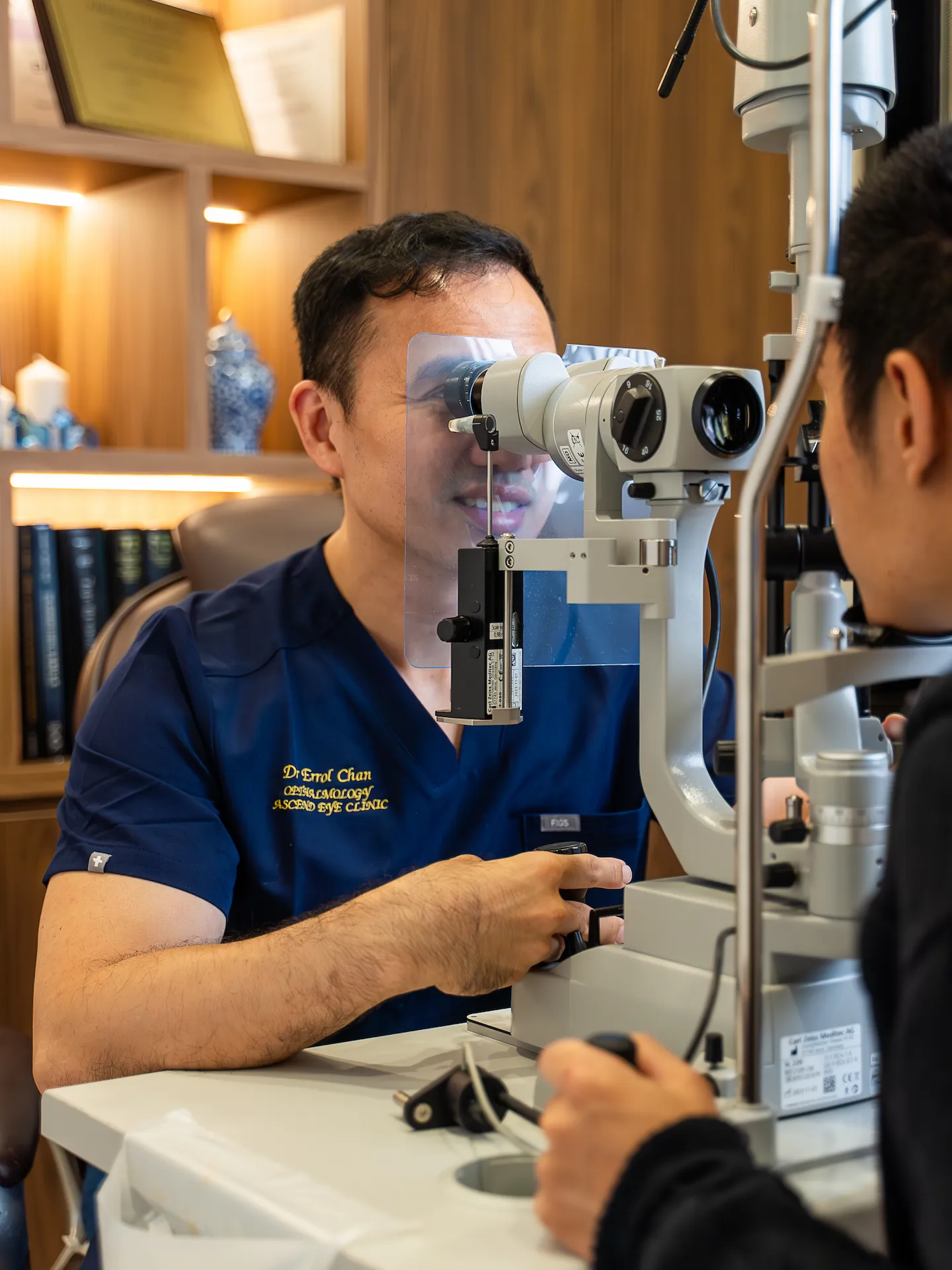
A careful eye examination helps determine how the cornea has been affected and identify the underlying cause of any changes in vision or discomfort. We will assess the clarity and structure of the cornea together with overall eye health to guide the appropriate treatment and follow-up.
Measures how clearly you can see and helps identify any reduction in vision caused by changes affecting the cornea.
Measures the eye’s focusing power and helps identify changes in spectacle prescription or astigmatism caused by alteration of the corneal shape.
Provides a magnified view of the cornea to identify abnormalities such as corneal swelling, scarring, inflammation, infection, thinning or changes to the corneal surface and layers.
Maps the shape and curvature of the cornea to identify irregularities, asymmetry or areas of abnormal steepening or thinning.
Maps the shape and curvature of the cornea to identify any distortion or astigmatism caused by the pterygium and assess how it is affecting the corneal surface.
Measures the number, size, and health of the endothelial cells lining the inner surface of the cornea, detecting reduced endothelial function.
Treatment is selected according to the diagnosis, severity of the condition, and its effect on vision and corneal health. Some mild or stable corneal conditions may only require monitoring or medication, while others require a procedure or surgery to restore the corneal surface, strengthen the cornea or prevent further progression.
Treatment may include:
At Ascend Eye Clinic, your findings and treatment options will be explained clearly. Where treatment is recommended, the approach will be tailored to the corneal condition, its severity, your visual needs and overall eye health.

From your initial consultation to treatment and follow-up care, our team will guide you through every stage of your journey. We will take the time to explain your condition, answer your questions and help you feel informed and supported throughout your care.

Your consultation begins with a detailed assessment of your vision and eye health. Depending on your condition, this may include measurements of your vision and eye pressure, examination of the front and back of the eye, and advanced diagnostic imaging.
Our team will guide you through each test and explain what is being assessed. Your results will then be carefully reviewed to understand your individual needs and determine whether monitoring or treatment may be recommended.
Every eye and every patient is different. Your treatment plan will be tailored according to your examination findings, visual needs, general health and lifestyle.
We will explain the recommended treatment, its expected benefits, possible risks and any suitable alternatives in a clear and straightforward manner. You will have time to ask questions and consider your options before deciding how you would like to proceed.
Before your treatment, our team will guide you through the necessary preparations, paperwork and medication instructions. Where applicable, we will explain how to use your prescribed eye drops and how to care for your eyes afterwards.
We understand that undergoing a procedure can feel unfamiliar or worrying. Our team will be available to answer your questions and ensure that you know what to expect before the day of your treatment.
On the day of your procedure, you will arrive at the hospital or surgical centre where your operation has been scheduled. The surgical team will help you prepare and explain what will happen at each stage.
Anaesthetic eye drops or other forms of anaesthesia may be used, depending on the procedure, to keep you comfortable. Your doctor and the surgical team will support and reassure you throughout the operation.
Most eye surgeries are performed as day procedures, although the duration and recovery process will depend on the treatment you receive. Your vision may be temporarily blurred afterwards, so you should arrange for someone to accompany you home and should not drive unless your doctor has advised that it is safe to do so.
We will provide clear instructions on how to care for your eyes, use any prescribed medication and manage your activities during recovery. We will also explain which symptoms are expected and when you should contact the clinic for further advice.
Follow-up appointments allow us to monitor your vision, assess your recovery and identify any concerns at an early stage. Our team remains accessible should you have any questions or concerns throughout your recovery.
If you are experiencing persistent redness, discomfort, light sensitivity or changes in vision, a detailed eye assessment can help identify the cause and determine the most appropriate treatment.
Book a consultation at Ascend Eye Clinic for a comprehensive corneal evaluation and personalised care aimed at protecting your comfort and vision.
Corneal conditions are disorders that affect the clear front surface of the eye. They may alter the smoothness, transparency, strength or shape of the cornea and can affect how light enters the eye and focuses on the retina.
Symptoms may include blurred vision, glare, halos, eye discomfort, redness, light sensitivity, excessive tearing or a persistent foreign-body sensation. Some corneal changes may initially cause few or no symptoms.
An assessment is recommended if you notice persistent blurred vision, increasing glare, eye pain, redness, sensitivity to light or a visible change on the surface of the eye. Sudden or severe symptoms should be assessed promptly.
Assessment usually includes visual acuity testing and a slit-lamp examination to examine the corneal surface in detail. Depending on the findings, additional tests such as corneal topography, tomography or thickness measurements may be performed.
Yes. Changes in the clarity, curvature or smoothness of the cornea can interfere with the way light is focused inside the eye, resulting in blurred or distorted vision, glare or changes in spectacle prescription.
No. Mild or stable changes may only require monitoring, while others may be managed with eye drops or other non-surgical treatment. Procedures or surgery may be recommended when the condition progresses, causes persistent symptoms or affects vision.
Some corneal conditions remain stable, while others can gradually progress. Regular monitoring allows changes in corneal shape, clarity or thickness to be identified and treatment to be recommended when necessary.
Eye drops can help manage certain causes of corneal irritation, dryness, inflammation or infection. However, structural changes to the cornea may require additional treatment depending on the underlying diagnosis.
A procedure may be recommended when corneal changes are affecting vision, progressing over time, causing persistent discomfort or cannot be adequately managed with medication alone. The type of procedure will depend on the part of the cornea affected and the underlying problem.
Treatment aims to address the underlying corneal problem and protect or improve visual function where possible. The expected visual outcome depends on the diagnosis, severity of the changes and whether other parts of the eye are also affecting vision.
Additional imaging may be required when more detailed assessment of the corneal shape, thickness or surface is needed. These measurements can help establish the diagnosis, monitor progression and plan treatment.
This depends on the condition and the health of the corneal surface. Contact lens wear may need to be reduced or temporarily stopped during treatment or assessment, particularly if the lenses are contributing to irritation or affecting corneal measurements.
Follow-up depends on the diagnosis and whether the corneal findings are stable or changing. Some patients only require periodic monitoring, while others may need closer review before or after treatment.
After treatment, eye drops may be prescribed and temporary blurred vision, light sensitivity or mild discomfort can occur depending on the procedure. Follow-up examinations are important to monitor healing and assess the response to treatment.
This depends on the underlying condition and the treatment performed. Some problems can recur or continue to change over time, so ongoing monitoring may still be recommended even after successful treatment.
Hi, I would like to book a consultation with Dr Errol Chan from Ascend Eye Clinic
