
Correct residual refractive errors following cataract surgery by implanting an additional lens for clearer vision.
A supplementary lens implant is an additional artificial intraocular lens placed inside the eye to correct residual refractive errors following cataract surgery. Unlike cataract surgery, where the natural lens is removed and replaced, a supplementary lens is implanted in front of the existing intraocular lens, without removing or replacing it.
Supplementary lens implants are used to correct residual myopia, hyperopia, astigmatism and presbyopia after cataract surgery. They provide an additional option for patients who continue to depend on glasses for clear vision or wish to achieve a broader range of vision following their initial surgery.
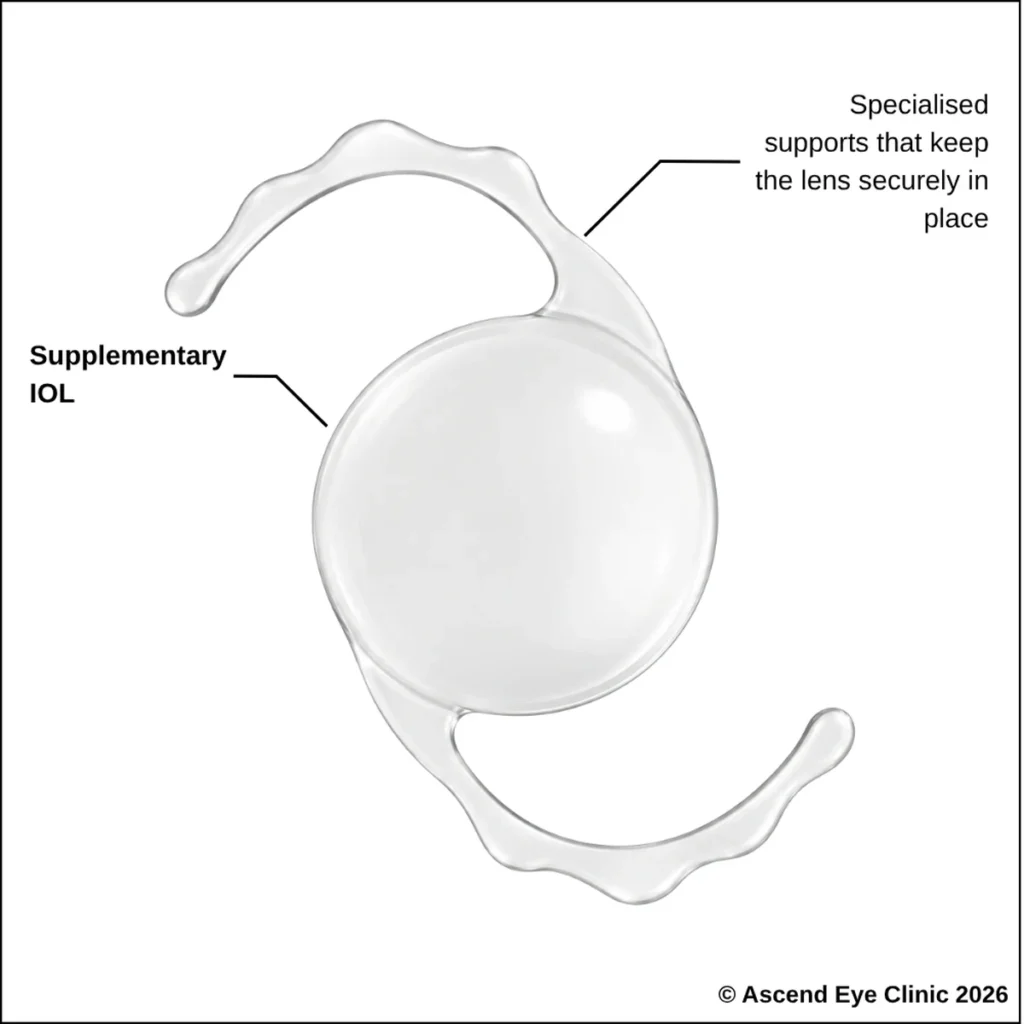
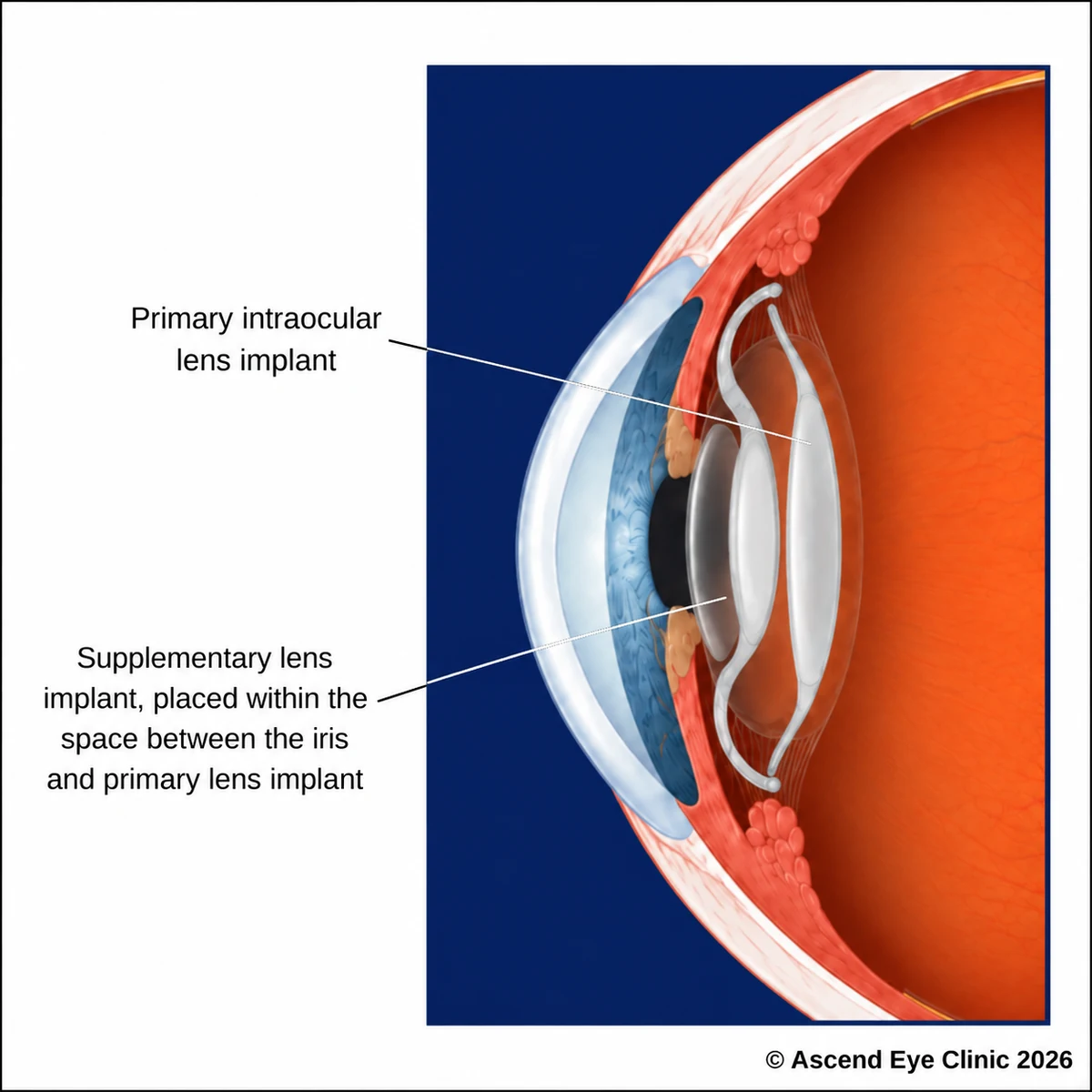
A supplementary lens implant is positioned in the ciliary sulcus, a space behind the iris and in front of the existing intraocular lens. The additional lens works together with the primary lens implant to adjust how light is focused onto the retina, correcting residual refractive errors.
Different supplementary lens designs address different visual requirements. Monofocal and toric supplementary lenses correct residual refractive errors, while multifocal supplementary lenses provide a broader range of vision across near, intermediate and far distances, reducing dependence on glasses for everyday activities.
The appropriate lens design is selected following a detailed assessment of the existing lens implant, eye anatomy and individual visual needs.
For patients who have undergone cataract surgery but are still not enjoying the clear vision they hoped for, supplementary lens implantation provides an opportunity to further refine their vision. Some patients continue to experience blurred or out-of-focus vision, glare and difficulty seeing clearly due to remaining refractive errors such as myopia, hyperopia and astigmatism. Others still require glasses for everyday activities despite having undergone cataract surgery.
The advantage of supplementary lens implantation is that the existing intraocular lens implant stays in place. An additional lens implant is positioned in front of it to fine-tune your vision, providing further correction without removing or exchanging the original lens implant. This also allows patients to address changing visual needs years after their initial cataract surgery.

We provide a broad range of supplementary lens implant designs to address different visual needs, including:
We will assess your existing lens implant, eye measurements and visual requirements to determine the appropriate supplementary lens implant design and correction for your eye.


From your initial consultation to treatment and follow-up care, our team will guide you through every stage of your journey. We will take the time to explain your condition, answer your questions and help you feel informed and supported throughout your care.
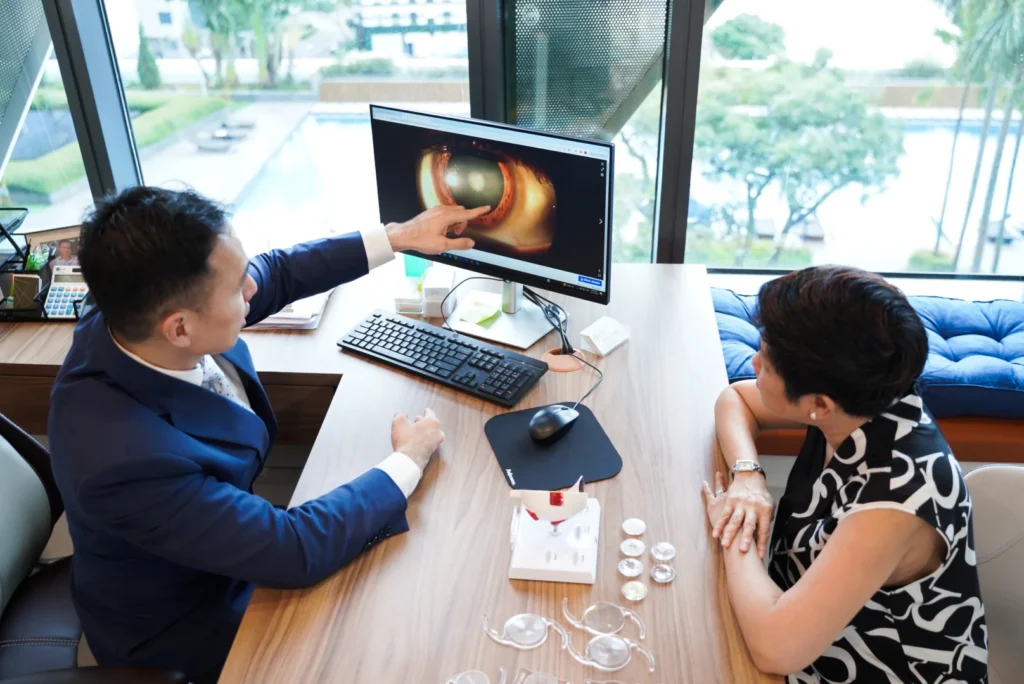
Your consultation begins with a detailed assessment of your vision and eye health. Depending on your condition, this may include measurements of your vision and eye pressure, examination of the front and back of the eye, and advanced diagnostic imaging.
Our team will guide you through each test and explain what is being assessed. Your results will then be carefully reviewed to understand your individual needs and determine whether monitoring or treatment may be recommended.
Every eye and every patient is different. Your treatment plan will be tailored according to your examination findings, visual needs, general health and lifestyle.
We will explain the recommended treatment, its expected benefits, possible risks and any suitable alternatives in a clear and straightforward manner. You will have time to ask questions and consider your options before deciding how you would like to proceed.
Before your treatment, our team will guide you through the necessary preparations, paperwork and medication instructions. Where applicable, we will explain how to use your prescribed eye drops and how to care for your eyes afterwards.
We understand that undergoing a procedure can feel unfamiliar or worrying. Our team will be available to answer your questions and ensure that you know what to expect before the day of your treatment.
On the day of your procedure, you will arrive at the hospital or surgical centre where your operation has been scheduled. The surgical team will help you prepare and explain what will happen at each stage.
Anaesthetic eye drops or other forms of anaesthesia may be used, depending on the procedure, to keep you comfortable. Your doctor and the surgical team will support and reassure you throughout the operation.
Most eye surgeries are performed as day procedures, although the duration and recovery process will depend on the treatment you receive. Your vision may be temporarily blurred afterwards, so you should arrange for someone to accompany you home and should not drive unless your doctor has advised that it is safe to do so.
We will provide clear instructions on how to care for your eyes, use any prescribed medication and manage your activities during recovery. We will also explain which symptoms are expected and when you should contact the clinic for further advice.
Follow-up appointments allow us to monitor your vision, assess your recovery and identify any concerns at an early stage. Our team remains accessible should you have any questions or concerns throughout your recovery.
If you have undergone cataract surgery but still experience blurred vision or dependence on glasses, a supplementary lens implant provides an opportunity to further refine your vision. By correcting remaining refractive errors, we aim to help you achieve sharper, clearer vision without removing or replacing your existing lens implant.
Arrange a consultation to find out how supplementary lens implantation can help you achieve clearer vision and greater freedom from glasses.
A supplementary lens implant is an additional artificial lens implant placed inside the eye to correct remaining refractive errors after cataract surgery. It is positioned in front of the existing intraocular lens implant, within the ciliary sulcus, without removing or replacing the original lens implant.
Some patients continue to require glasses after cataract surgery due to residual myopia, hyperopia or astigmatism. Others find that their existing lens implant provides clear distance vision but does not fully meet their near or intermediate vision needs. A supplementary lens implant provides an additional means of correcting these visual requirements.
Yes. Supplementary lens implantation can be performed in both eyes if further vision correction is required. Surgery is generally performed on separate occasions, allowing the first eye to recover before proceeding with the second eye. We will assess each eye individually to determine the appropriate treatment.
Yes. Supplementary lens implantation can be performed months or years after the original cataract surgery, provided the eye is suitable. We will assess the position of your existing lens implant, the health of your eye and your current refractive error before recommending treatment.
No. One of the main advantages of supplementary lens implantation is that the existing intraocular lens implant remains in place. The additional lens implant is positioned in front of it, avoiding the need for lens implant exchange.
Yes. Toric supplementary lens implants are designed to correct residual astigmatism after cataract surgery. By correcting the remaining astigmatism, treatment aims to provide sharper vision and reduce dependence on glasses.
No. The supplementary lens implant is positioned entirely inside the eye, behind the iris. Once implanted, you will not be able to feel it, and it will not interfere with blinking or normal eye movements.
Lens implant exchange involves removing the existing intraocular lens implant and replacing it with another. Supplementary lens implantation leaves the original lens implant in place and adds a second lens implant to provide further correction. This avoids disturbing the existing lens implant and its surrounding capsular support.
The procedure is performed under local anaesthesia, with mild sedation where appropriate, to keep you comfortable throughout. You will generally feel little or no pain during surgery. Mild discomfort, irritation or a gritty sensation can occur during the initial recovery period.
Supplementary lens implantation is generally a short surgical procedure performed as day surgery. The actual operating time depends on the condition of your eye and the complexity of the procedure. Additional time is required for preparation and monitoring after surgery.
Many patients notice an improvement in vision within the first few days after surgery. Vision can initially appear blurred due to temporary inflammation and other changes associated with healing. Visual clarity gradually stabilises over the following weeks.
We generally recommend allowing a few days for initial recovery, depending on your occupation and how quickly your vision settles. Patients with desk-based jobs often return to work sooner than those whose work involves heavy physical activity, dusty environments or strenuous exertion. We will advise you on when to resume your usual activities.
As with any intraocular surgery, supplementary lens implantation carries risks, including infection, inflammation, raised eye pressure and changes in lens implant position. Other potential complications include glare, halos and contact between the supplementary lens implant and surrounding eye structures. We will assess your eye and explain the relevant risks before surgery.
Yes. Supplementary lens implants are designed to be removable or exchangeable if clinically necessary. However, removal requires another intraocular procedure and carries its own surgical risks. We will carefully assess your eye measurements and visual requirements before selecting the supplementary lens implant.
We will perform a detailed eye examination to assess your existing lens implant, residual refractive error, corneal health, anterior chamber anatomy and overall eye health. We will also discuss your visual requirements, including your dependence on glasses for distance, intermediate and near activities. Based on these findings, we will determine whether supplementary lens implantation is appropriate and recommend a suitable lens implant design.
Hi, I would like to book a consultation with Dr Errol Chan from Ascend Eye Clinic
