
Advanced imaging and detailed eye measurements allow careful planning when replacing an unsuitable, displaced or previously implanted lens. Treatment is tailored to the condition of the eye, visual concerns and lifestyle needs, with careful attention throughout the procedure and recovery.
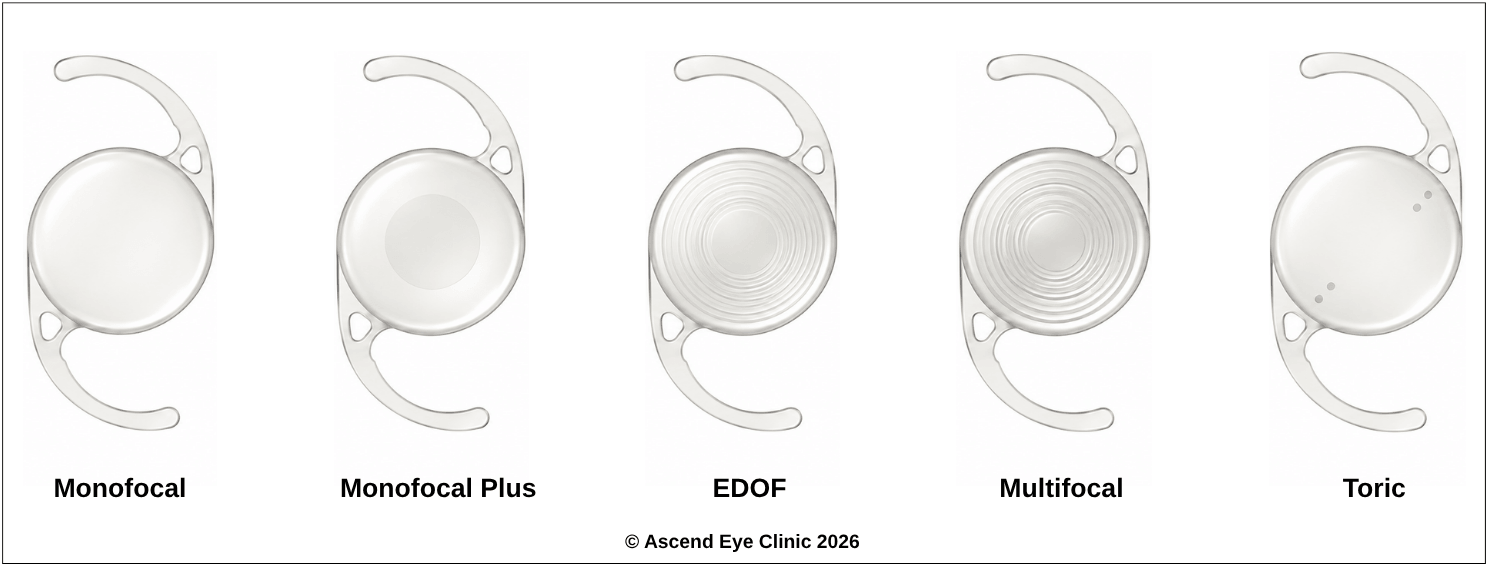
An intraocular lens (IOL) is the artificial lens placed inside the eye during cataract surgery. An IOL exchange removes this lens and replaces it with a new lens that is better suited to your eye and visual needs.

An IOL exchange is recommended when the implanted lens is affecting your vision due to:
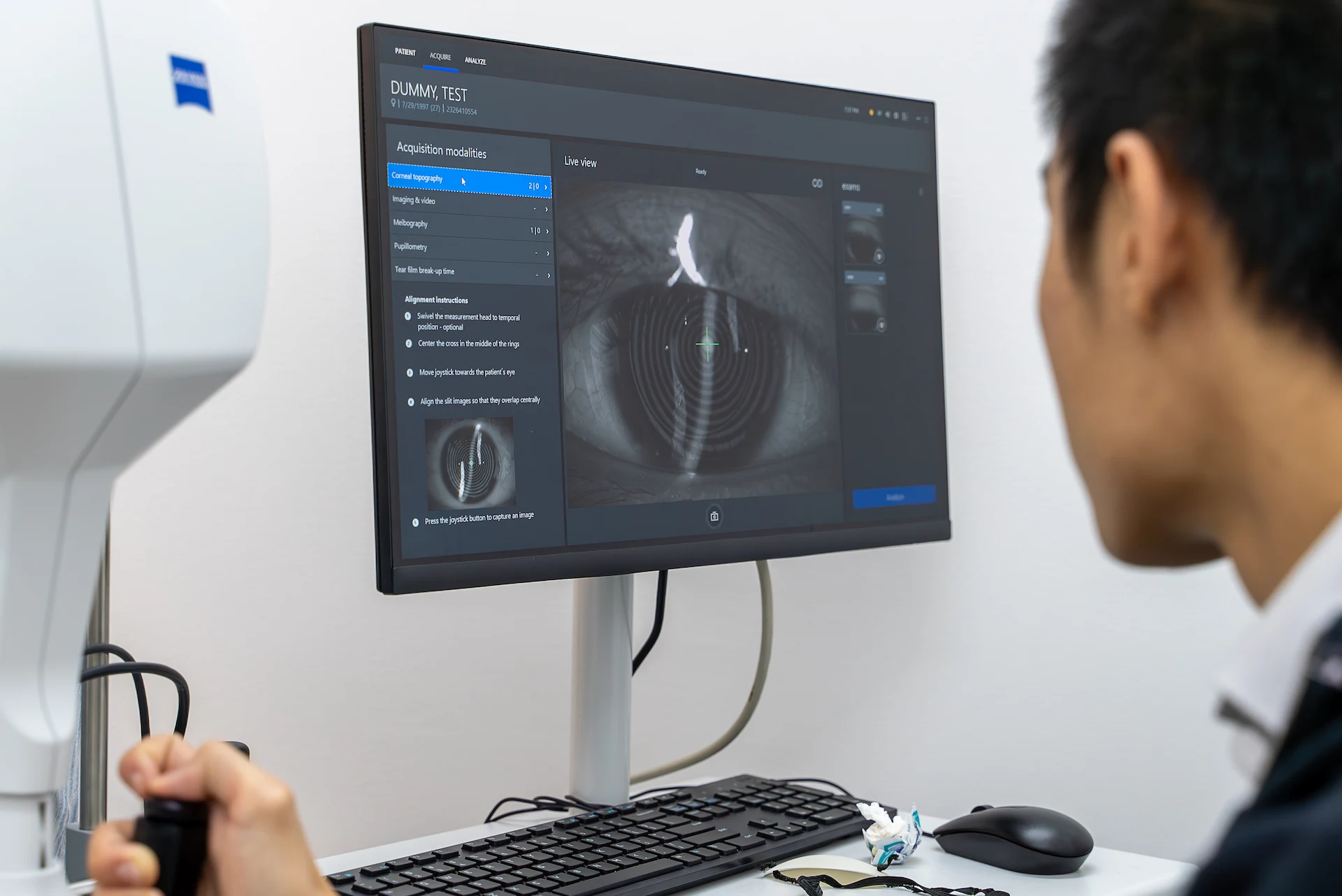
Before recommending surgery, we will perform a detailed assessment to examine your existing IOL, cornea, retina, optic nerve, and posterior capsule. These measurements help us confirm whether the implanted lens is responsible for your symptoms and rule out other causes of reduced vision and plan the most appropriate treatment for your eye.
If recommended for surgery, the replacement lens is selected according to your eye health, prescription, lifestyle, and preferred range of vision.
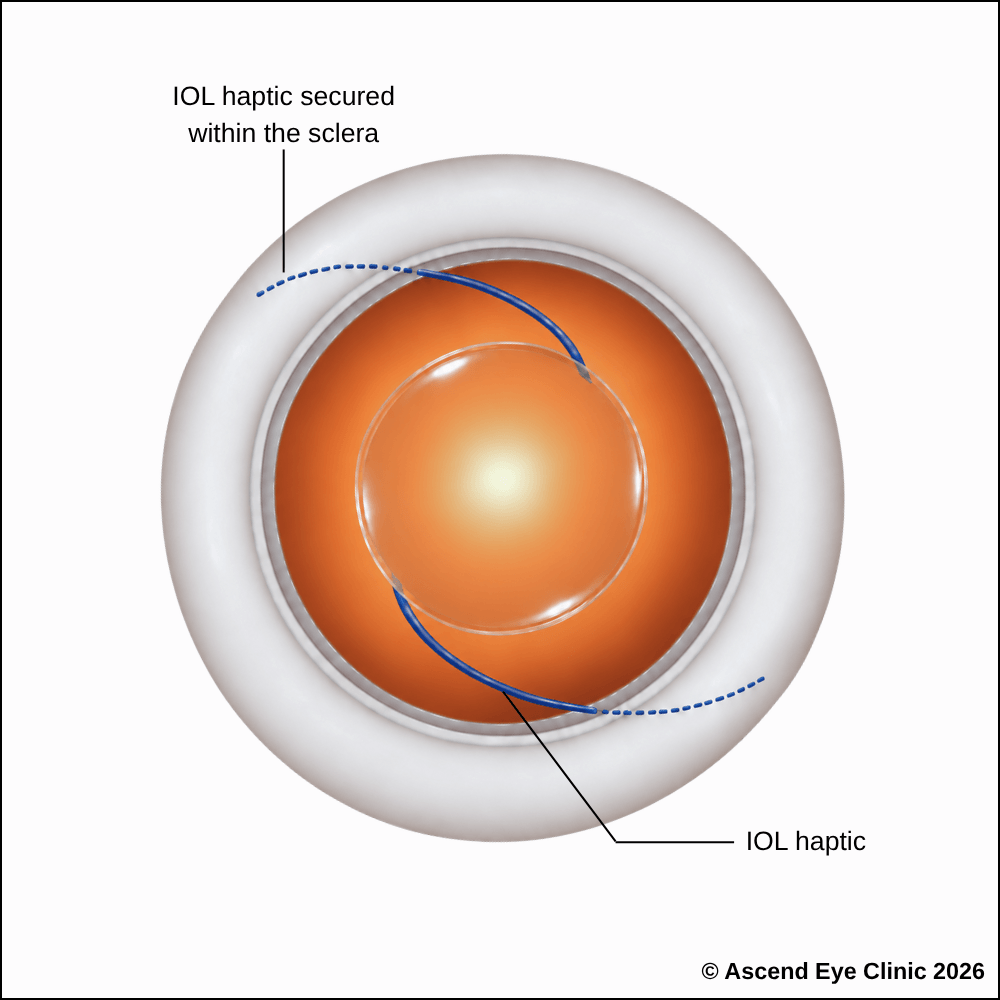
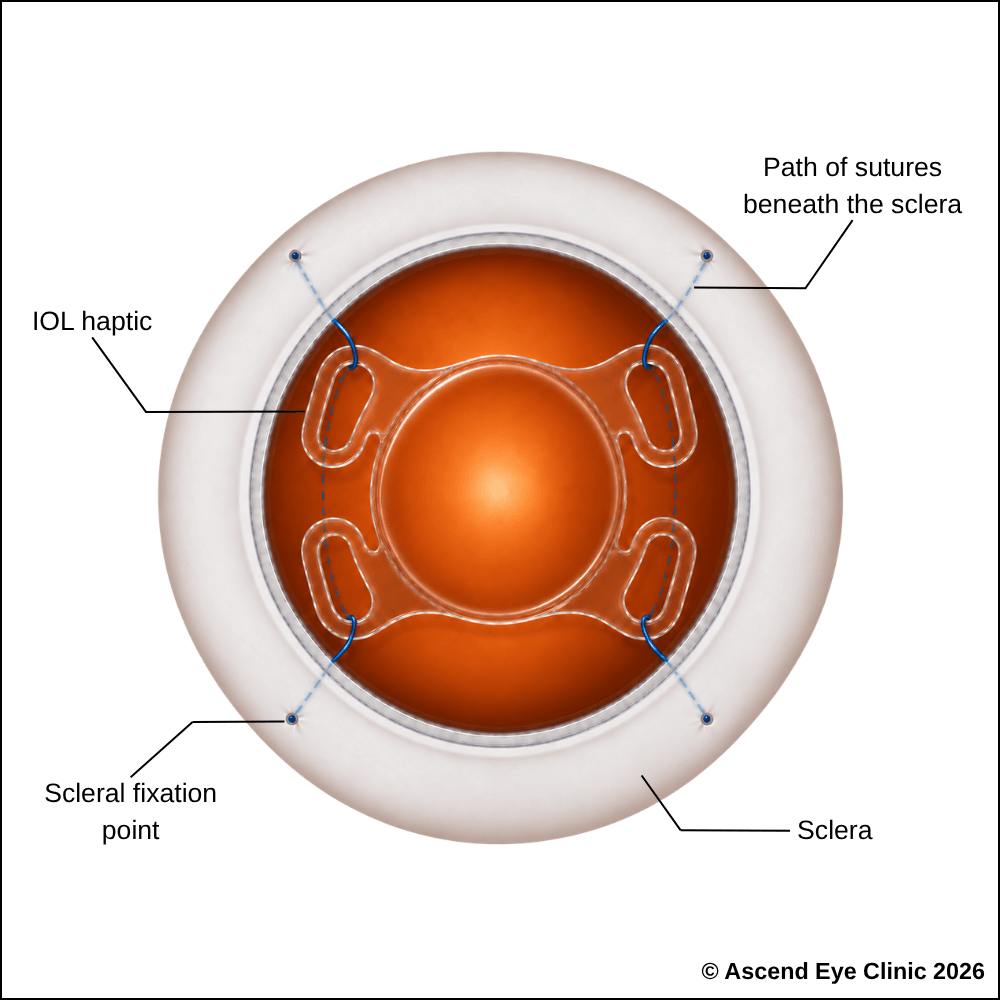
In IOL exchange surgery, an unstable or displaced IOL will need to be removed and replaced with a new lens. This lens is fixed to the sclera, the white outer wall of the eye.
The replacement IOL is secured to the sclera using either the Yamane sutureless technique, which fixes the lens in place using its haptics without sutures, or four-point Gore-Tex® suture fixation, which secures the lens to the sclera at four points using Gore-Tex® sutures. Both techniques position the replacement IOL behind the iris and provide stable support without relying on the natural lens capsule.
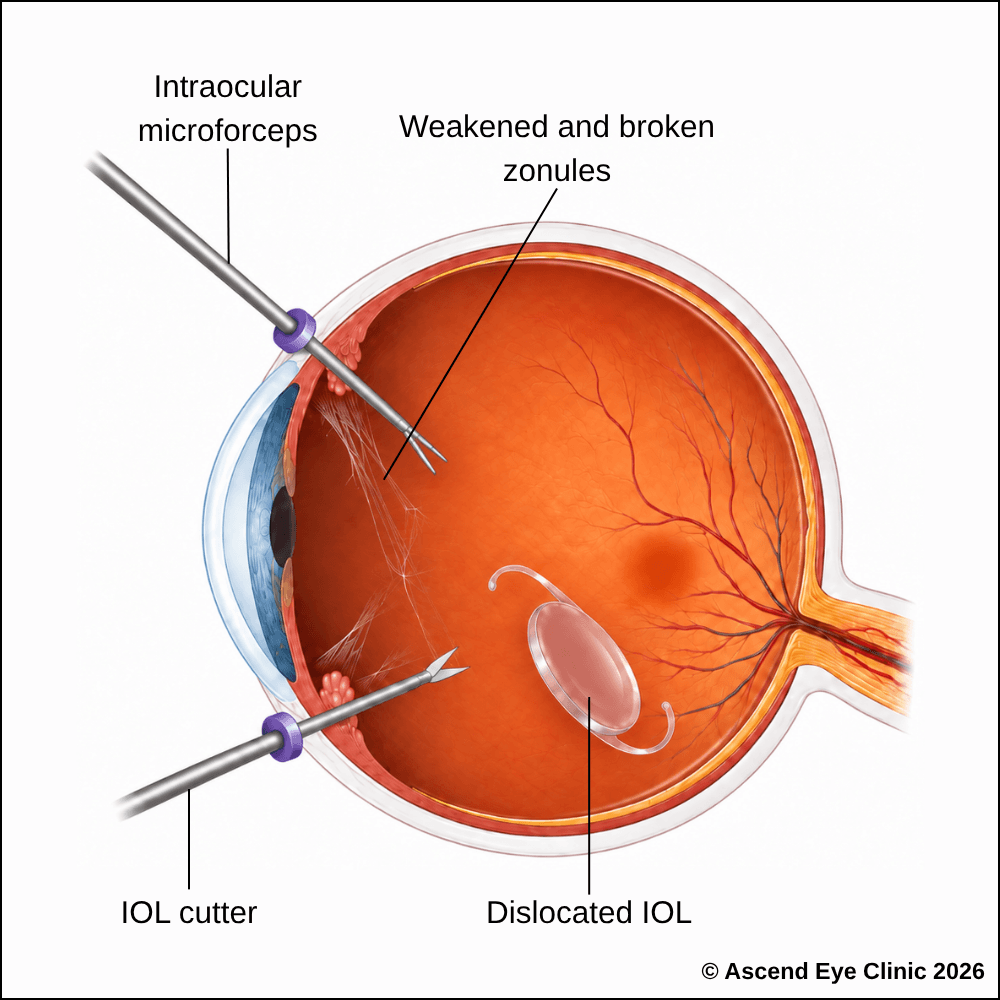
If the displaced IOL has fallen into the vitreous cavity at the back of the eye, a vitrectomy is required to safely retrieve it. This is a microsurgical keyhole procedure performed through several small ports in the white part of the eye. Fine instruments are used to remove the vitreous gel and free the IOL safely. Once the IOL has been freed, it is removed through an incision with fine forceps. The retina and surrounding structures are then inspected to ensure the back of the eye remains stable.
A secondary IOL is then implanted and secured to the sclera using either the Yamane sutureless technique or four-point Gore-Tex® suture fixation, as described above.
From your initial consultation to treatment and follow-up care, our team will guide you through every stage of your journey. We will take the time to explain your condition, answer your questions and help you feel informed and supported throughout your care.

Your consultation begins with a detailed assessment of your vision and eye health. Depending on your condition, this may include measurements of your vision and eye pressure, examination of the front and back of the eye, and advanced diagnostic imaging.
Our team will guide you through each test and explain what is being assessed. Your results will then be carefully reviewed to understand your individual needs and determine whether monitoring or treatment may be recommended.
Every eye and every patient is different. Your treatment plan will be tailored according to your examination findings, visual needs, general health and lifestyle.
We will explain the recommended treatment, its expected benefits, possible risks and any suitable alternatives in a clear and straightforward manner. You will have time to ask questions and consider your options before deciding how you would like to proceed.
Before your treatment, our team will guide you through the necessary preparations, paperwork and medication instructions. Where applicable, we will explain how to use your prescribed eye drops and how to care for your eyes afterwards.
We understand that undergoing a procedure can feel unfamiliar or worrying. Our team will be available to answer your questions and ensure that you know what to expect before the day of your treatment.
On the day of your procedure, you will arrive at the hospital or surgical centre where your operation has been scheduled. The surgical team will help you prepare and explain what will happen at each stage.
Anaesthetic eye drops or other forms of anaesthesia may be used, depending on the procedure, to keep you comfortable. Your doctor and the surgical team will support and reassure you throughout the operation.
Most eye surgeries are performed as day procedures, although the duration and recovery process will depend on the treatment you receive. Your vision may be temporarily blurred afterwards, so you should arrange for someone to accompany you home and should not drive unless your doctor has advised that it is safe to do so.
We will provide clear instructions on how to care for your eyes, use any prescribed medication and manage your activities during recovery. We will also explain which symptoms are expected and when you should contact the clinic for further advice.
Follow-up appointments allow us to monitor your vision, assess your recovery and identify any concerns at an early stage. Our team remains accessible should you have any questions or concerns throughout your recovery.
Book a consultation at Ascend Eye Clinic for a detailed assessment of your implanted lens and visual recovery. We will identify the cause of your concerns and recommend further treatment when necessary.
Your eye needs time to heal and your prescription needs to stabilise after the original surgery. We will also address treatable causes of poor vision, such as dry eye or residual prescription, before deciding whether an exchange is necessary.
Yes. You can have good visual acuity but still experience glare, halos, poor contrast, ghosting or uncomfortable night vision. An IOL exchange focuses on your overall quality of vision, not only the smallest letters you can read.
Night-time glare, halos and starbursts are important when they interfere with driving or daily activities. We will assess whether they arise from the implanted lens, your pupil size, the cornea or another eye condition.
Yes. Depending on your eye health and visual goals, your replacement lens can have a different power or optical design from your existing IOL.
A monofocal lens generally provides clearer vision at one selected distance with fewer multifocal optical effects. You will usually require glasses for the other distances, particularly reading.
Yes, when the remaining lens provides comfortable vision and the two eyes continue to work well together. We will assess the difference in focus and visual quality between both eyes before recommending a one-eye exchange.
Monovision is an option when one eye is targeted for distance and the other for nearer vision. We will assess your suitability and discuss how this arrangement affects depth perception and visual balance.
A toric replacement lens corrects suitable levels of corneal astigmatism. Corneal topography and biometry determine the lens power and alignment required.
Yes. Previous laser vision correction changes the shape of the cornea and makes IOL power calculation more complex. Advanced corneal measurements and your previous treatment records help us improve the accuracy of the calculation.
Yes. An exchange remains possible years later, although scar tissue and capsular fibrosis make the procedure more technically complex. A detailed examination determines the safest surgical approach.
The replacement lens is positioned using another method, such as fixation to the sclera. Your surgeon will select the technique that provides the most stable lens position for your eye.
No lens guarantees complete freedom from glasses. Your need for glasses depends on the replacement lens, the intended visual target, astigmatism and the health of your eye.
Yes. Modern measurements improve refractive accuracy, but healing and individual differences in lens position affect the final prescription. Most eyes achieve a result close to the intended target.
Laser vision correction remains an option for a stable residual prescription when your corneal thickness, shape and eye health are suitable. We will assess this only after your eye has fully recovered.
Contact us immediately if you develop severe eye pain, rapidly worsening redness, a sudden drop in vision or a new curtain or shadow across your vision. These symptoms require urgent examination.
